
Historic Hood River
Horse and Buggy
2-6-2012
Notes

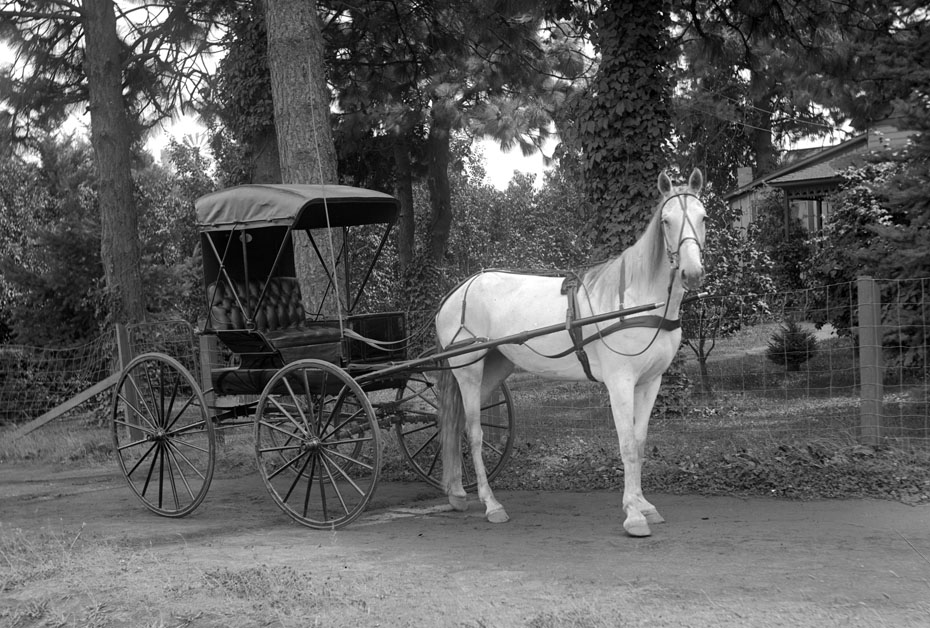
I’m not sure if it is technically correct to call this a “horse and buggy” but hopefully someone will fill us in on the correct nomenclature. I just know it is a beautiful image of a bygone era.
A different sort of puzzle for you today: this glass negative was broken in two pieces. I’ve stitched it up in Photoshop. Can you find the crack?

Charlott
Maybe one crack way down in the bottom right hand corner about 1 and 1/2 inches up from the side?
I personally would put this in the catagory as horse and buggy. Looking at the horse, which is magnificent, I think that it was a dual purpose stead, to pull the buggy and possibly a riding horse. Seat in the buggy would definitely be leather.
Jim Gray
I was thinking the 2 lines in the upper right that look like power lines, noticed the windmill between the 2 pine trees. It is really a fine looking horse & buggy, any idea of location?
Allen
"Crack the whip" Yoda says!
Connie
I have looked closely at that buggy and I think it is the same one that we have in the museum. Here is the scoop"¦.
The earliest history known of this buggy was that it was found in a barn when Toy Hotchkiss bought a 500 acres farm along the Little Spokane River, north of Spokane, Washington. About 1957 this buggy was given to George D. Heisley, Jr., who was the chief executive of Hood River Distillers, Inc. The buggy was first stored on the Heisly ranch and then later stored in the buildings of Hood River Distillers in Hood River.
When Marie Bartmess Marshall passed away in 1986, George Heisley gave the buggy to Marie’s son Ned to have it restored and donated to the Hood River County Historical Museum in her memory.
In February 1988, the buggy was delivered to Merrill (Mel) Farrington in Mulino, Oregon for the restoration. Mr. Farrington does restoration for the Oregon Historical Society, so when he was finally able to complete the restoration (including the canopy, upholstery and original red pin-striping) it was February, 1991, at which time it was delivered to the museum.
Marie Louise Bartmess Marshall was born in Hood River on November 5, 1897 and lived here for her entire 89 years. She was very active on the museum board. More of the Bartmess family history can be found in the museum.
This buggy has attached to it (upside down to conserve space) a single tree which has been restored. A double tree (for two horses) is available but was not restored. Contact Hood River Distillers for more information about it.
This buggy has been restored for "static display only." As of 1991 the axles and hubs are sound. A trained horse and driver could probably safely pull the buggy in a parade, but Mr. Farrington will accept no responsibility.
Arthur
A few notes:
The defect Charlott identified is a deep scratch in the emulsion, not the crack in the plate.
Jim is correct, those are power lines (and/or telephone). I suspect the image is from about 1905-1910, and up near Belmont, but the evidence is weak.
I’ve also compared this buggy with the one in the museum. They look identical to me in form and style. I don’t know how standard buggy designs were, but this is at least the same model buggy in my opinion. When you all visit the Museum next season you can see for yourselves.
l.e.
I agree with Jim. That is a fine looking horse and buggy.
I’m sure that is a buggy whip standing up like an antenna so you can probably call it a buggy.
I tried to find some history on woven wire fence. I thought that might help date the photo. The fence appears to have been in place for a while.
In 1895, woven wire patents were in a legal battle, so I don’t think it was being manufactured yet. Maybe not until 1900.
David Bowles
I remember this buggy, or one very much like it, in the barn at the Heisley place in Oswego in the fifties. They had a couple acres at the end of Egan Way. Mrs H (Betty, I believe) was the horseperson in the family. There was some talk of riding in the Rose Parade with the buggy…..