
Historic Hood River
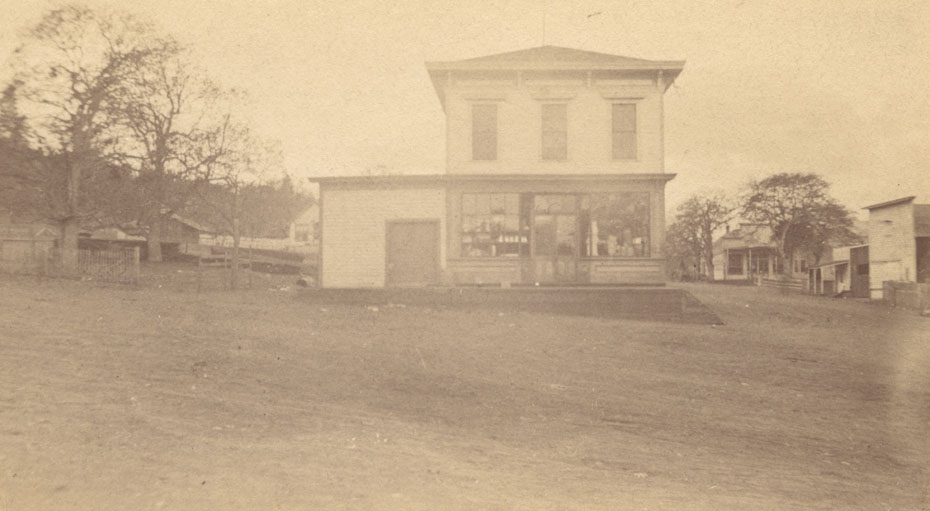
E. L. Smith Store
1-4-2012
Notes

Here’s a great early view of the E.L. Smith store at the corner of Oak and Second. The photo probably dates from the early 1890’s, though it could be from the 1880’s. Looking up Oak Street you can also see the A.S. Blowers store building at the corner of 3rd and Oak (behind those two nice Oak trees). I believe both these buildings were constructed in 1882. Mr. Blowers opened his market about 1889.
The E.L. Smith Store appeared in this drawing as well as this old photo.
We’ve also seen it in a slightly later view when it was owned by George Crowell.
Category: Downtown Hood River
Tags: 1890s, 2nd Street, AS Blowers Store, EL Smith Store, George Crowell Store, Oak Street
Tags: 1890s, 2nd Street, AS Blowers Store, EL Smith Store, George Crowell Store, Oak Street

l.e.
Both Mr. Smith and his wife were college educated. They first moved to California and then to Olympia where he served as Washington Territorial Secretary. They moved to the Frankton area in 1876. Their property ran from State street, south to Belmont.
He established a general store at the junction of Belmont and State roads and was involved in Wasco County government and the state electoral college.
In 1882 the store was moved, (I don’t think phsically), to the new town of Hood River. The Smith Family moved their residence to 6th and State.
l.e.
Ezra Smith’s family was buried in the Frankton Cemetery, but Ezra later felt cremation was the better plan. He himself was cremated and his family interred and cremated.
Jeffrey Bryant
You can see why it was called Oak Street.
Charlott
Shows how sparcely settled downtown was. Most of the oaks had been cut in this area, but further west, out of the view of the picture there were mawny more….
Jeffrey Bryant
The Hood River Glacier, July 16, 1908, page 2
HOOD RIVER TO LOSE OLD LAND MARK
With the removal of the large wooden building occupied as a store by R. B. Bragg & Company, Hood River is about to lose one of its oldest and most interesting land marks.
For many years its broad steps and long stoop have served in the capacity of the meeting place, forum and lounging spot for Hood River’s inhabitants and we think it is safe to say that there is not a man in Hood River valley who at some time has not rested his anatomy on this ever convenient roosting place. It has been the center for discussions affecting both town and nation and the chosen spot for gossip. "I’ll meet you on Bragg’s corner" are bywords that are about to lose their significance in the march of progress. To its regular habitues the demolition of this public sitting place is looked upon as something approaching an outrage and we are informed that if possible an injunction would have been secured to stay the hand of the iconoclasts who with ax and crowbar pried apart the time worn boards that afforded rest for the weary.
As to the building, it was erected in 1882 by E. L. Smith who for a number of years conducted a general store in it. When build it was by far the most pretentious structure anywhere in the vicinity of Hood River and was the only building on the block. Later Mr. Smith sold the stock of goods to A. S. Blowers who took his son Lawrence into partnership and conducted the business under the firm name of Blowers & Son.
Afterwards Mr. Blowers sold a half interest in the business to Geo. P. Crowell. When Mr. Blowers decided to retire he sold his interest to Mr. Crowell, who also bought the building from Mr. Smith, paying $3,500 for it.
As storekeeper of the largest mercantile business at Hood River Mr. Crowell also acted in the capacity of its banker and for several years and one who had any money deposited with him. In fact until about 1900 when the Butler Banking Company opened its bank here, Crowell’s store was the center of all financial transactions of any magnitude. At that time very little coin was jingling in the pockets of Hood River residents and the occasion for spending more than two bits necessitated the issuing of an order on Geo. Crowell. When Mr. Crowell went out of business he sold the stock of goods to R. B. Bragg & Company and afterwards disposed of the building to Dr. T. L. Eliot. Later Mr. Eliot sold the property to Chas. Hall who is about to replace it with a brick business block.