
Historic Hood River
Hood River Japanese Community, 1916
Notes

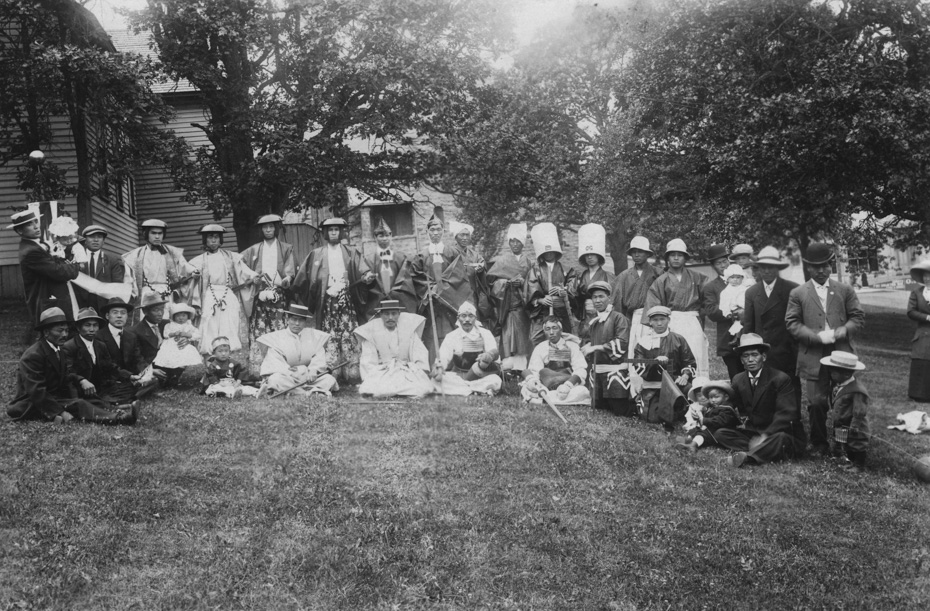
We have a treat today. Homer Yasui, who grew up in Hood River, has sent me a few pictures to share with you. Do you remember Arline Moore’s photo of the “Parade of Americans of Foreign Birth” which occurred on July 4th, 1916? Well, Homer has some wonderfully clear photos from the same day. He describes this group as “Japanese enactors,” and provides some additional description: “Among this group, is my father (Masuo Yasui), sitting third from the left; and my Uncle Renichi (Yasui) Fujimoto, standing at the extreme left, and carrying my oldest brother, Kay Yasui.”
If you have read “Stubborn Twig” you will be familiar with the history of the Yasui family in Hood River. If you have been to recent July 4th parades, you will remember that residents of our sister city, Tsuruta Japan, have marched in the parade in very similar costumes.
I’ll save the parade picture for the July 4th weekend, but since it’s Monday it’s time to answer a question he has posed: “I think that this was taken on the Court House lawn, but I sure would appreciate help on pinning down the exact site.”
Here’s my answer to him. Feel free to add or correct any details:
The masonry building in the background is the Riverside Church, which is still at that location (though it has a large addition to the west). The courthouse in 1916 was the old schoolhouse from 1883. Sometime after Hood River County was formed in 1908, the school was converted to a courthouse. After the Butler Bank went under during the Great Depression, the court was moved into that building on Oak Street. A new courthouse building was erected on the site of the 1883 schoolhouse in 1954. If you look at that right side of that photo you can see the building which is in the background of your photo.
I’ll add my own question for readers: What is the symbolism of the costumes in this image?
It’s fun to see Historic Hood River is still being discovered by people all over the country (and world). Remember to check the Comment RSS feed if you want to see what people are saying about older image posts. That link is at the bottom of each page.

Dan
Feel bad for the two guys that had to wear the 5 gallon buckets.
Melody Shellman
The "5-gallon buckets" are wicker baskets. The two wearing the baskets are dressed as itinerant monks of the fuke tradition, whose meditation consisted of playing a bamboo flute (shakuhachi) for hours in time with their breathing or walking. The wicker baskets usually cover the face (pushed up here for the photo) and have openwork weaving in front of the eyes so they can see where they’re going. The covering of the head is symbolic of denial of the ego, or something like that.
Arlen Sheldrake
Father John L. had many stories about working with the Japanese families in the Valley as a Deputy Sheriff. He always admired the family traditions and respected their rules. Arresting a Japanese youth was not the way, taking the problem to the family elder was and he said it worked well.
Grandfather John H. was very proud of getting the new courthouse built and expired soon after.
Melody Shellman
What I find interesting is that the "costumes" reflect middle- and upper-class status. You couldn’t just buy these clothes back then, unless you were of the right class or family. As these folks likely brought the clothing with them when they came to the States, it indicates that many of the immigrants came from well-to-do (or once well-to-do) families. I think I even spy some samurai.
nels
For those who have read "Stubborn Twig" visiting the burial site of that family is an emotional experience. It is located in the very northeast corner by the stop light corner (Tire Factory on one side and the physical therapy place on the other.)
L.E.
I was looking at this photo of "cultural heritage" which was used in a parade. Arthur notes that some of this same dress is still used in a parade by visitors from Japan.
When you watch a parade, many costumes and groups, denote "cultural heritage".
If a group of people from the U.S., immigrated to another country and walked in a parade, what type of dress would they wear that would reflect their "United States cultural heritage?
Off the top of my head, I can’t think of any. Maybe a cowboy.
Today’s parades in the U.S. still seem to be made up of "cultural groups" that immigrated here.
Homer…..do you know who the man sitting down on the far left is?
Buzz
L.E. your comment intrigued me. Being part German, Polish, English, and Scottish, and raised on a Indian Reservation, what would I wear as part of my heritage in a foreign parade. How about tennis shoes, levis, and a sweatshirt and go as an American.
Arthur
L.E.s question reminded me of the story about FDR serving hotdogs to the king of England.
Homer Yasui
L.E., I’m sorry but I don’t know/recognize the gentleman seated on the left side. I don’t recognize anybody else in that picture except my father, my uncle and my oldest brother. Of interest to me, is that there is a Nikkei (Japanese) woman standing on the extreme right hand side of the picture; and that in 1916 there already were a number of Nikkei kids. I probably knew some of them in my later years, but I wasn’t born until 1924.
Homer Yasui
Melody, I don’t think that the clothing that the Japanese re-enactors were wearing for this 4th of July parade, were actually clothes that they brought over from Japan. These are/were costumes of the feudal days in Japan, and even today, in Japan, during their "Jidai Matsuri" (an earlier period celebration or festival) this sort of costume is commonly worn.
There are representations of samurai in this photograph, but as far as I know, no Hood River Nikkei (Japanese) descended from samurai stock.
L.E.
I am not sure how long links to the HR News last, but I thought this recent article about "Minoru Yasui Day" should be noted.
http://www.hoodrivernews.com/news/2016/feb/17/salem-tour-supports-minoru-yasui-day/