
Historic Hood River
Debris Pickup
12-17-2018
Notes

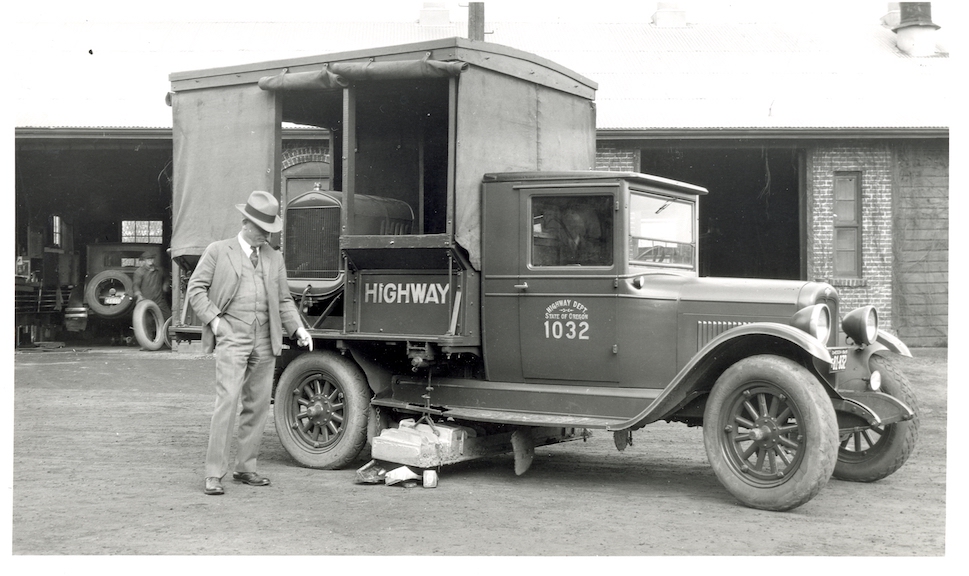
This image is courtesy of our friends at ODOT. Homer J. Hana, an engineering professor at Washington State College in Pullman, published this design in an engineering journal. A large electromagnet is used to sweep the road of material such as nails and car parts. The magnet was powered by a 3KW DC generator driven by a Model T engine transverse mounted in the truck. The photo was probably taken at the State Highway Department yard in Salem, but you can be sure the truck saw service on the Columbia River Highway.

Dale Nicol
Too bad the electromagnet was not mounted ahead of the front wheels as horse shoe nails was a major cause of flat tires. I wonder how many flats the truck had while working the road ways?
Buzz
Wonder how long this scheme was used. Why do I have the feeling that Rube Goldberg would have found this to be an interesting idea?
Stever
I spy a reflection in the door glass. Hum … ?
Kenn
I still see them used on road shoulders but those I see are mounted on the rear of trucks ~
L.E.
How did you clean the magnet?
longshot
My father who grew up without having shoes for day to day use, stated that the best thing about the automobile was that it ridded the roads of horseshoe nails and the accompanying infections from the parasites in the horse droppings getting into the cuts on ones feet.
longshot
Ford Model AA truck?
Arthur
It’s definitely a Chevy truck. You can see the "bowtie" up front. The engine to power the magnet is a Ford Model T engine.
They could control the power of the magnet by controlling the speed of the Model T engine, as well as with a rheostat. i think they would just shut down the engine to drop the collected metal from the magnet. The electromagnet might have a bit of residual magnetism, but most of its holding power would be lost.
Arthur
ODOT sent me a photo of a canvas sheet on poles which they would slide under the truck to collect the debris when they turned off the magnets. That answers L.E.’s question.