
Historic Hood River
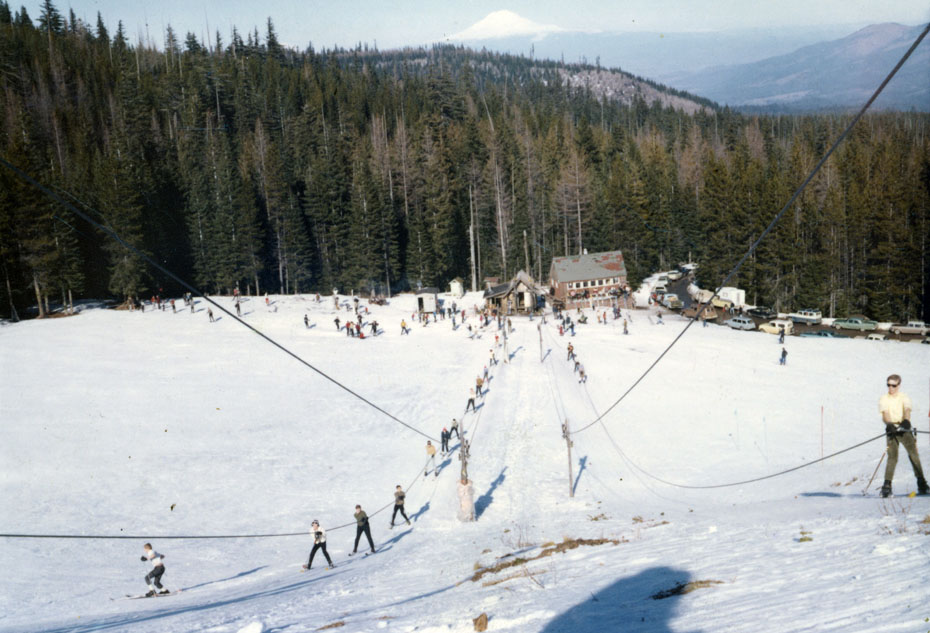
Cooper Spur Ski Area, 1967
12-9-2011
Notes

It’s nice to see the world in color for a change. Here is Cooper Spur ski area in the winter of 1966-67. Feel free to fill in the history of this local ski slope, or just think pleasant thoughts about all the great ski days yet to come this winter.

Charlott
Oh wow….Again. I spent 10 years of my life operating the kitchen at Cooper Spur. Also managed to shatter my ankle. I can see the spot.
History of Cooper Spur as I know it…….Originally there was just "Jump Hill" off to the right, where the "Finns" had built a jump.
My first indoctrination to Cooper Spur was right after the war, when Jack Baldwin returned from the war and got it up and running. Used old diesel engines to operate that old rope tow and "world famous T-bar."
The so called lodge in those days, was just an old A-frame with a barrel for a stove. That A frame sat about where that rope tow shack is in photo.
I don’t know when this particular lodge was built, but it is the one that burnt down and replaced the existing one.
Charlott
sorry, something happened before I finished.
This rope tow is located about where the Homestead chair lift is now. The old t-bar was way off left of the picture.
You can see the two outhouses behind that tow shack.
This photo was taken very late in the spring of 1967, because of the patches of dirt showing in the snow and the fact that the fellow is wearing a short sleeved shirt. Believe me, I know, in the dead of winter one does NOT dress like this at Cooper Spur.
(Just a note. Go forth without me as I shall be on vacation until the 19th. But I will catch up with you then.)
Dan
That young man on the far right arms are starting to get tired holding up that heavy rope. I know from experience.
Dan
I also worked as a ski patrol at Cooper for a few years in my late teens. Sometimes if it was going to snow all weekend a couple of us would stay overnight in the patrol hut at the bottom of the hill. We would spend Saturday night hiking up the hill and skiing back down in the fresh powder. Sometimes we would even sneak the lights on for a few hours after we thought Jack had gone to bed down in Hood River.
What a great photo. I actually have a photo of our now Sheriff Wampler loading me on the tee bar a million years ago. I have a lot of great memories growing up skiing at Cooper.
Melanee
I learned to ski at Cooper too, with lace-up leather boots and thick leather gloves to protect from that nasty rope tow. The t-bar came later, scared me to death. Maybe that’s why I enjoyed the fresh donuts better than skiing (still do!)
Charlott
That is why the t-bar was so sought after when it went and the Homestead chair went in. Everyone had a love/hate feeling for it. The t’s were sold for $20 each, with the proceeds going to the volunteer ski patrol that Cooper Spur had. The t’s were in such hot demand that in the end they actually had go go into the shed where old parts of them were and assembled as many as they could to sell.
I watched as the t-bar towers were removed. They had been sold to some small ski area, not sure where, Idaho maybe. A helicopter came in, attached a cable to each tower and litterally jerked it straight up out of the ground. Then ferried it over to the parking lot where they were loaded on a low boy truck for transportation. Those towers came out a lot faster than they went in, that is for sure.
Charlott
Dan, your tour of duty must have been after electricity was supplied, as for a number of years after it was started up after WWII it did not have electricity. Ski area was run with old probably WWII surplus diesels. Ski area had to close on Sunday much earlier to get everything put to bed before it got dark. In the early years when I first remember Jack Baldwin, Myron Weygandt and a couple of others stayed all week end, I know as I was the best friend of one of the Weygandt girls and we went up very early Saturday morning and slept in the top of the A-frame where we had to throw open the window or cook from that old barrel stove from downstairs. I do not know for certain when the electricity was put in there.
We had woolen mittens and those things would get water logged very quickly. Always had to have a few spare pairs to make it through.
No one had their fancy ski togs of now that cost a lot of $$$$$$$$$$’s. Many wore pajama bottoms under jeans. You were one of the lucky if you possessed a water proof jacket. But we survived. Maybe more hearty than skiers of now. I have so many stories of Cooper Spur, should write a book…..
Dan
I guess I started skiing at Cooper around the year 1969 give or take a few. It seems like for the first few years I skied they had the diesel. I seem to remember that Jack had to make the fuel last as best he could through out the year.
CB
I remember that on the really steep part of the rope tow, lots of times people could not hold on tight enough sometimes and would start sliding back and people coming up from below them would either have to jump off or they’d be in a crash. You could buy a little metal apparatus that would cling to the rope and you could release at the top.
Then sometimes friction of the rope sliding would make it wet and your gloves or that thing (toe belt maybe?) would freeze to the rope. When you got to the top, you’d be frozen to the rope and you’d go through that safety gate.
Charlott
Those of us living through the rigors of learning to ski at Cooper Spur have accomplished momumental in the world of skling. One spent as much time sliding backwards on the rope tow as making forward movements. Can you imagine what could have transpired had we had a tube run?
Watching the tube run at Cooper Spur can be quite entertaining. Not that one wishes to see anyone injured, but I have seen some fairly wild rides provided by those who did not follow instructions from the tube run operator. Right to the end, up over the berm shooting off into space and plunking down in the parking lot. Fortunately, not injured and not allowed on the tube run again.
steve s
Too bad all those skiers were not taught the proper technique for using a rope tow. It is far more efficient and far less tiring to grab the rope in front of you (as they are doing) and then move your right arm and hand behind you and grasp the rope and simply lean back on your fist. I learned that technique as a boy scout earning a merit badge way back in the mid fifties and used it teaching on the rope tow at The Meadows in 2005 and 2006
Dan
Trust me steve, we all became experts at holding on to the rope at Cooper. The problem with the rope on the right side of the photo is it would drag in the snow if the passengers were to far apart. This would cause ice to form on the rope which made it impossible to get any grip with out the metal "jaws" hooked to your belt.
Paul Kollas
I have always been under the impression that the first engine used there was a 6 cyl Chevrolet engine (gas, not diesel). Also under the impression that that engine didn’t last long. I’m pretty sure it was Roger Getchell who told me that– he was among the earliest devotees.
steve
best post award-
" That young man on the far right arms are starting to get tired holding up that heavy rope. I know from experience."
Thanks Dan !! I remember the feeling- wanting to get to the top…. grip… please grip- don’t slip….
Thomas Turner
A bus ran from May Street School to Cooper Spur. The equipment was put down below; I believe the cost was 50c for a round trip; it ran on Saturdays.
Susan Turner
Yup, I remeber the bus ride up. The gloves frozen onto the rope (I just pulled my hands out!), and the perilous 45-second slide back down!
Dave Read
Learned to ski there at Cooper about that same time, on heavy wooden skis that felt like concrete lashed to my feet. This brings back all the memories of the perils of trying to use that dang rope tow. The skiing was fun, but I grew to hate that tow rope so much that I refused to use rope tows for decades afterward!
Jeffrey Bryant
Hood River Glacier, 1927-08-18, page 2 – Article on naming of Cooper Spur and other points on Mt. Hood, and making a path to the mountain.
https://oregonnews.uoregon.edu/lccn/sn97071110/1927-08-18/ed-1/seq-2/