
Historic Hood River
Crowd Size
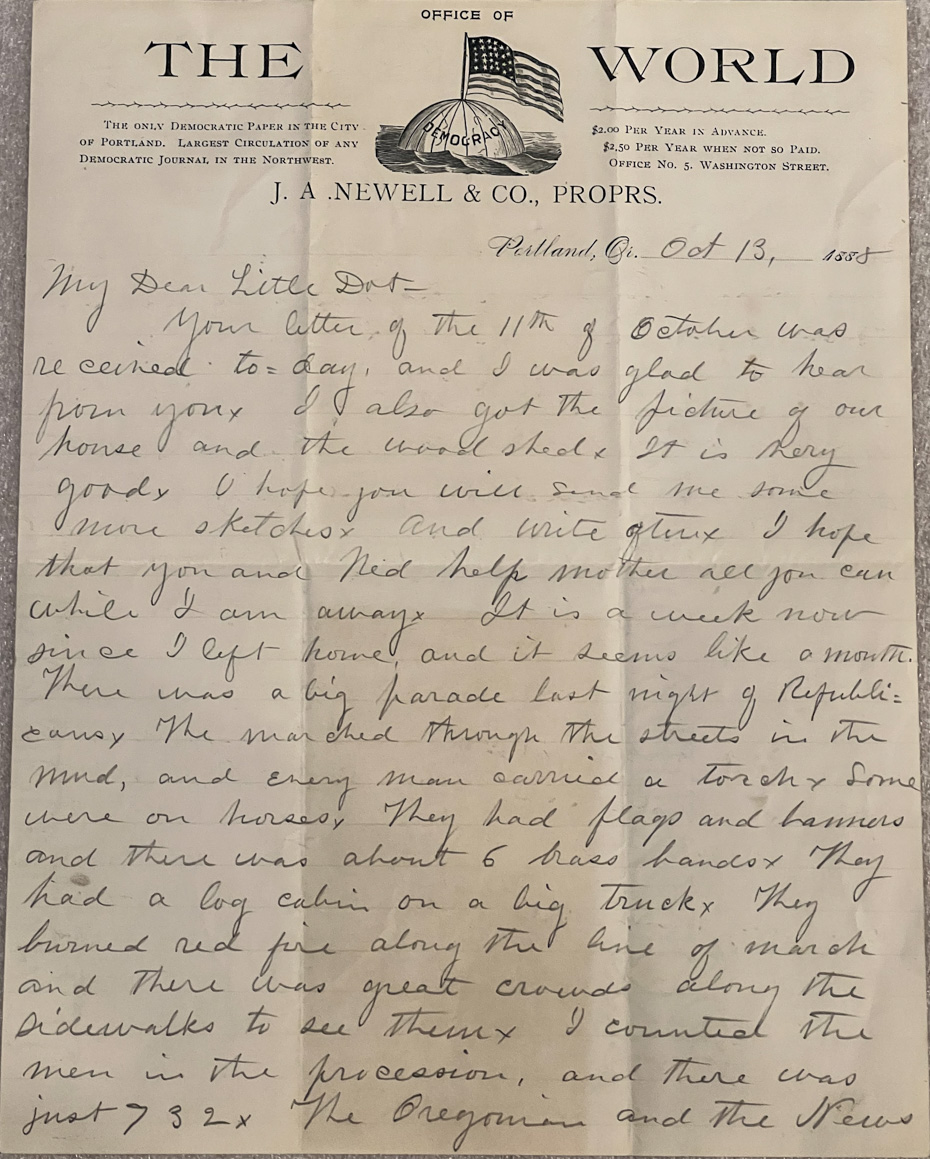
Notes
In the 19th century it was common for newspapers to have a declared partisan affiliation. This October, 1888 letter from Samuel Blythe to his young daughter, who he affectionately calls “Dot”, is on stationery from The World,” a “Democratic Paper” in Portland. I’m not sure if he was working for them. He wouldn’t become the publisher of The Hood River Glacier until 1894. The writing style shows a side of Blythe we didn’t see in the Glacier writings, and the content offers a charming view into the politics of the era. Or is it timeless?
Portland, OR Oct 13 1888
My Dear Little Dot,
Your letter of the 11th of October was received to-day and I was glad to hear from you. I also got the picture of the house and the woodshed. It is very good. I hope you will send me some more sketches, and write often. I hope that you and Ned help mother all you can while I am away. It is a week now since I left home and it seems like a month.
There was a big parade last night of Republicans. They marched through the streets in the mud, and every man carried a torch and some were on horses. They had flags and banners and ther was about 6 brass bands. They had a log cabin on a big truck. They burned red fire along the line of march and there was great crowds along the sidewalks to see them. I counted the men in the procession, and there was just 732. The Oregonian and the News this morning said there was over 3000 men in the lines. The Democratic papers will probably say that it was not much of a parade and that there was about 500 men and boys in line. So you see that Democrats and Republicans cannot count alike.
I hope this will find you and mother and Ned and Grandpa all well. Love to all, Your affectionate father, S.F. Blythe.
Tags: Blythe, election, election day, newspaper, political rally, politics, Portland

Pat A
I read all of it in cursive.
Great exercise for my eyes and brain.
Loved learning cursive, it made me feel more adult to be able to understand this writing style!
james
What’s with the x for periods. If I were his teacher, I’d straighten that out…..! (It’s his personal style I know).
Arthur Babitz
James, I thought maybe the “x” for periods was a typesetter thing. If you’re setting type from handwritten copy I could see a benefit to not accidentally missing the punctuation because a “.” could be mistaken for a speck on the paper.