
Historic Hood River
Tintype
Notes

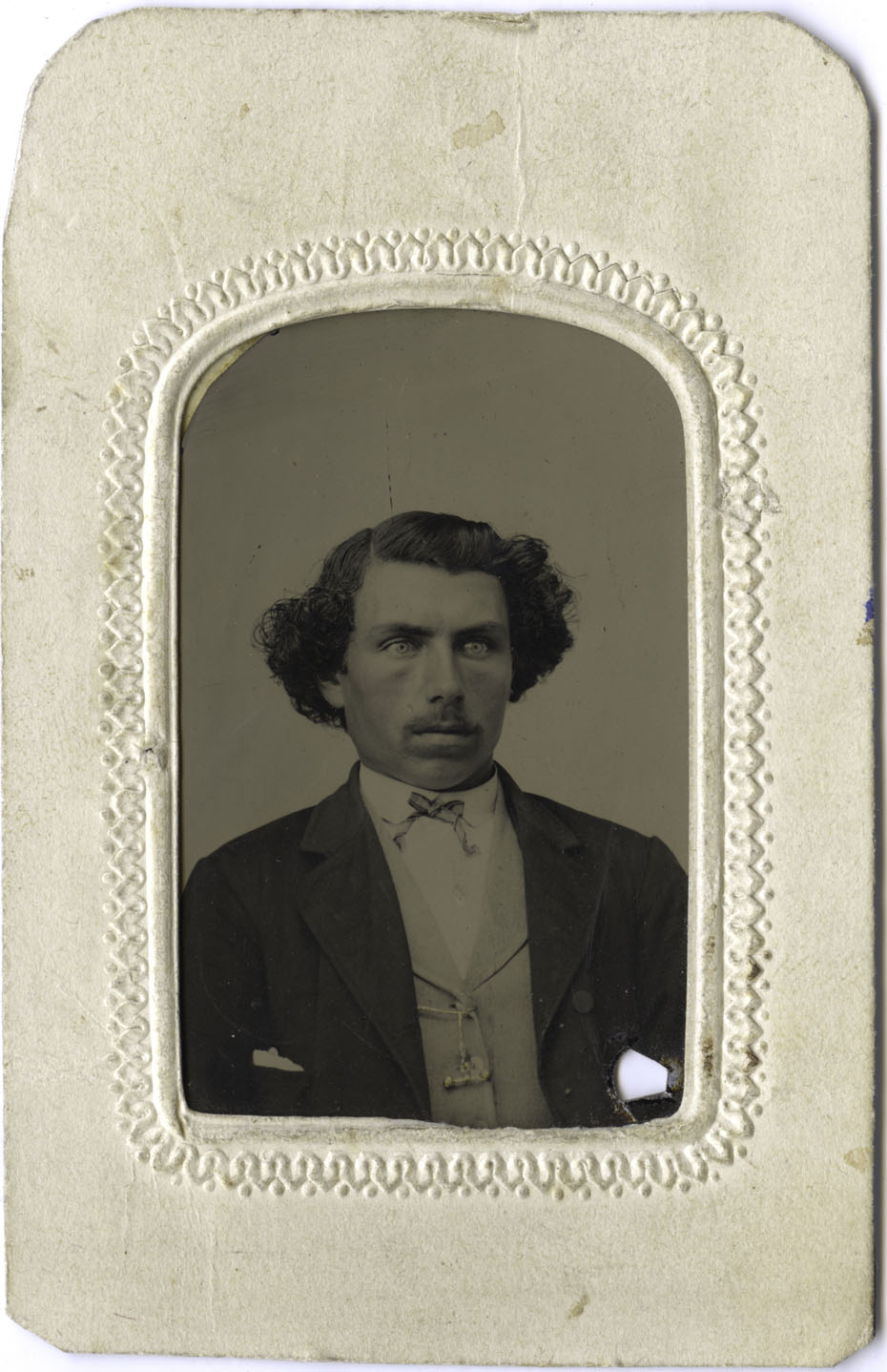
The Museum has many old family photo albums, and most of them start with a few tintype such as this. The tintype was an important step in the democratization of photography. The earlier daguerreotypes were expensive and fragile, involving a silver-plated polished copper plate which had to be sandwiched in glass to protect the fragile image. The tintype was made by exposing a wet emulsion on a backing of blackened iron (not really tin). From the 1850’s until they faded from popularity in the 1890s they were an affordable way for families to share keepsakes. They could be sent through the mail, so many Civil War soldiers sent tintypes back home.
It was very common for tintype portraits to be touched up as we see here. After developing the wet plate, the photographer would add a little blush to the cheeks and a dab of gold, in this case to the chain on his vest. The image was then varnished and ready to take home– an early “while you wait” photo process. The tintype was a direct (no intermediate negative) process, so if you have a tintype in your family album you can be sure no one else has a copy. This also means that most tintypes are laterally reversed, like looking at yourself in the mirror.
Most of the tintypes in the Museum’s collection are of unknown ancestors. We know little more than the location of the studio where it was prepared. If you have any tintypes in your album, try to identify the subject. It won’t get any easier.

Connie
Great image – and great information. Imagine how precious these images were to family members who received them from far away. Quite different than our "instant" digital world of Skpe and Facebook. These images are such treasures.
Charlott
So sad that apparently there is no name. This is WHY one should always write who, where and when on back of their photos. I am thinking that that might be a watch fob attached to his button/button hole, though generally they were lower so the watch could be in a pocket.
There were photographers during the Civil War that actually followed the armies, setting up their little booths to take the photos, much like Brady did with his "Whatsit" wagon, his portable dark room for the now famous Civil War pictures.
l.e.
Arthur, I think with each photo, I gain more love for this project you are doing.
Thanks for the explanation of how tintypes were made.
Having just returned from a family reunion where everyone was taking a multitude of photos with their digital cameras, I agree with Connie.
These images must have been very precious to the family.
J.E. Sheppard
That is a watch key on the end of the watch chain, which leads to a watch in his right-side pocket. The key was used to wind watches before the common stem winder came into almost universal use. The key with the chain attached at the middle by means of a swivel device made an excellent button to hold your time piece. I have a similar one that belonged to my grandfather. I never had the old watch that it wound!
Arthur
I should have noted this tintype comes from an album with a note it is from the J.W. Hinrichs family, so we at least of some clue who this might be.
kmb
Is it possible this might be a photo of the young John W Hinrichs himself? The gentleman in the photo looks like he might be in his 20’s, and if it were John Hinrichs, would place the photo in the 1860’s.
Arthur Babitz
I think kmb is correct identifying this as a young John W. Hinrichs. I’ve compared features at several ages and the match appears strong. This is likely Civil War era or just after. It was common for young men to send a tintype home after enlisting.