
Historic Hood River
“Indian Houses”
4-15-2014
Notes

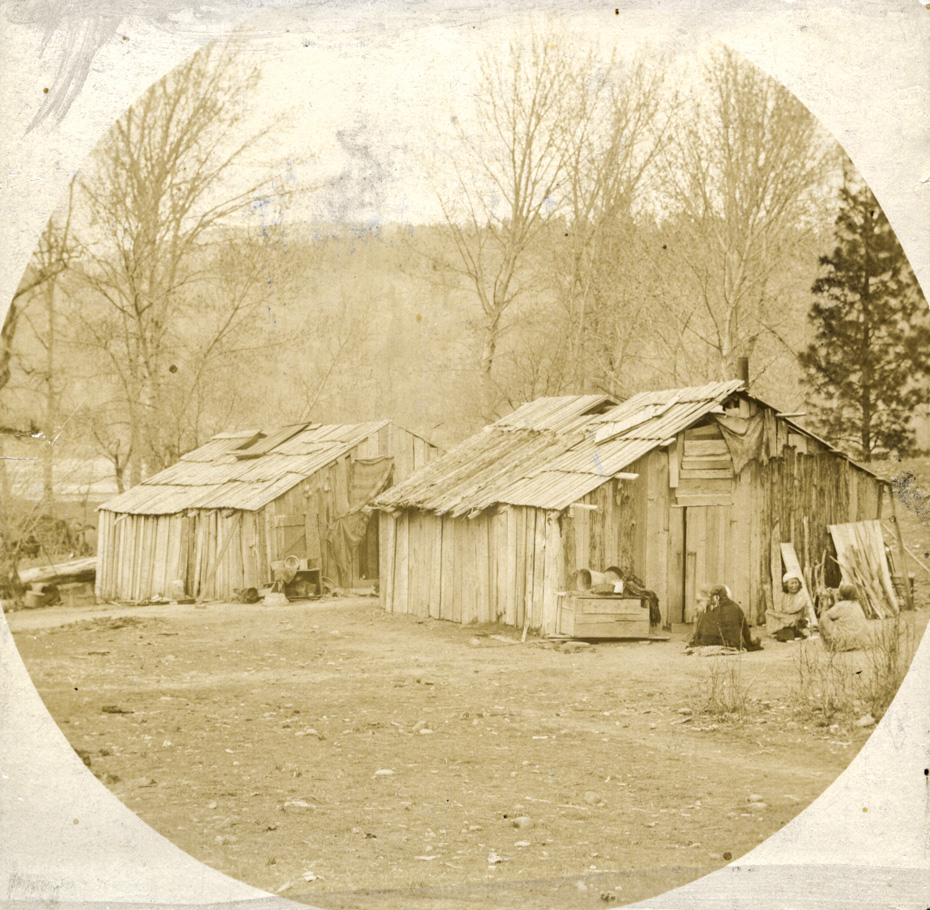
This image is captioned, “Indian Houses, east of Hood River north of railroad.” Note the openings in the roofing to allow smoke to exit. One of the huts also has a stovepipe.
We don’t have a date, but this circular vignetting of the image was common in the 1890s to the very early 1900s. The first Kodak film cameras (1888) came from the factory with film for one hundred 2 1/2″ diameter circular images. The lenses of that era were not very good, which is especially obvious in the corners of a square image. The photographer would send the camera back to Rochester so the film could be developed and the camera reloaded with new film.

charlott
I am wondering if that might not be a portion of the river behind? Or maybe one of the sloughs along there. Beings they were river Indians they would have been fairly close to the water.
Pretty cold homes in the winter I would think. I would imagine that strong wind would whip right through there. I see a piece of board up there near the smoke hole. Wonder if they put that over when not in use?
Also see the back shack, doesn’t have a door, but a blanket. Would be interesting to know how many buildings made up this little tribes home.
Rawhyde
As the far shack appears to be on uneven ground, I wonder if it was for fish smoking? Does anyone know when the native populations began using these style structures?
l.e.
Looks darn cold doesn’t it? I would say they probably didn’t live there year round but it looks like winter time.
It could be early spring and they have moved down to the river waiting for the arrival of the salmon.
Could those be the White Salmon hills in the background?
Wow, can you imagine sending camera and all back east. No Fed Ex in those days either.
Buzz
Pretty hard to get much concentrated smoke to the fish in a place that big. Lot of indians spent more time just air drying fish out in the open than hard smoking it. Would guess these places were tucked in behind something and not battered by strong gorge winds.
l.e.
Is anyone else having trouble getting the COMMENT RSS feed to work?
charlott
I know at Celilo they smoked them right out in the open around this gigantic fire. They had them sort of skewered and periodically the young girls would go around and turn them.
Longshot
Looks like large openings in both of the roofs have "doors". I suspect they only got closed off in the worst weather. The smoke would have been overwhelming otherwise.
Buzz
Lot of different ways to preserve fish by air-drying, hot or cold smoking, or cooking. Sounds like the celilo’s were mostly cooking it with a little smoke if they had to keep turning them. Did they brine them first?
Buzz
Would guess indians started living in these kinds of structures whenever they could scrounge up enough material to build one. Roof on one appears to be partly metal sheeting and scrap lumber.
Longshot
Looks like part of the one roof and also parts of the walls may have been made from peeled bark.
charlott
No brine that I remember. They just cleaned them, ran a good sized stake length wise, then some small ones across, so the fish wouldn’t curl and stabbed the end of the big stake near the fire.
AJ
maybe around Koberg beach?
Charlott
I agree that the Indian village was somewhere in the vicinity of Koberg’s.