
Historic Hood River
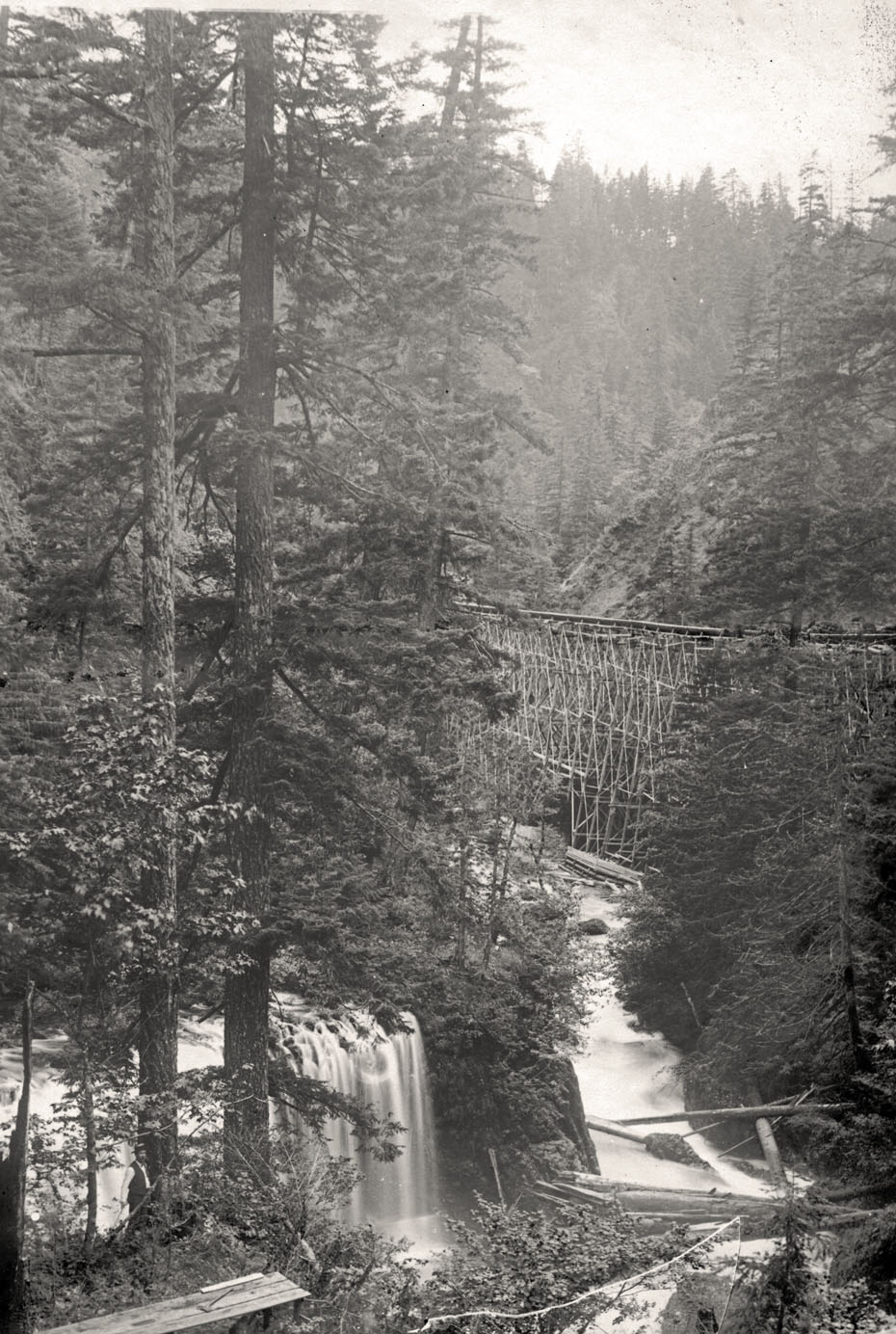
Flume at Spirit Falls
9-27-2013
Notes

The Oregon Lumber Company used a flume to move rough sawed logs from the Chenowith Mill to a landing on Drano Lake, where they would be barged across the Columbia to the planing mill at Viento. This is where the flume passed by Spirit Falls on the Little White Salmon.
Here’s a modern view of the falls (without the flume) courtesy of Scott Cook’s Curious Gorge.
We’ll see the rest of the journey “from tree to lumber” next week.

spinsur
Wow! Looks too spindly to hold the builders, let alone rushing water and logs (cants?)! Interesting the way it "bridged" the river wide spot. So the "fella" in the pic appears to be leaning on an ax, and there’s a fellin’ axe, and maybe a springboard on the "landing"; but what is the landing for? Surely they weren’t building an access to get to the trees for falling… were they? And really, dress in your vest, tie, and hat to work in the woods…
l.e.
Now that, is impressive.
Surely someone must have died while building that spindly thing.
Took me a while to find the "fella".
Thanks for these photos Arthur.
Buzz
I could see how all the triangles built into it could bear the downward pressure of the load, but I have to believe it is tied into the hillside somehow to keep it from toppling over sideways. The guy standing by the tree looks more like an engineer admiring his handiwork.
Arthur
We have another view which shows the engineering in more detail, but I’ll tell you it does not look any more stable from that point of view. I suspect this was rebuilt on a regular basis, and I doubt it survived a single winter without major reconstruction.
The text I provided two days ago describes tunnels through rock and narrow walkways carved in rock to support the flume. I suspect those would be the only evidence of this flume to survive the ages, other than these photographs.
Leslie Williamson
Does anyone have information on the Hurlburt Bridge? I guess it was built in the late 1920’s. It was supposedly designed by a gentleman named Hurlburt who I just discovered is my grandfather. Thanks for any information.
Jeffrey Bryant
I’m not sure if the engineering design was similar to the flume or not, but my great grandfather, Robert Vaughan, built railroad trestles for Oregon Lumber Company up toward Lost Lake.
spinsur
Leslie, not familiar w/ a "Hurlburt Bridge", but the County had an engineer/surveyor by name of Hurlburt, I think in 19-teens era. I’d have to look it up. if you google Hood River County, you should be able to get to the County Surveyor eddress. Email him, I hear he’s a real nice guy, and perhaps can get you a little more info.
Jeffrey Bryant
It is likely the Hurlburt was Carroll Merwin Hurlburt. History of Hood River County, 1852-1987 pages 281-282 tell about him.
Bill P.
Carroll "Tubby" Hurlburt who lived west of the intersection of Sunset and Country Club Road was very friendly and helpful to all as an advisery civil engineer. He not only was insturmental in the moderization of the Farmers Irrigation System, but aided the City of Hood River in advising on changes in their water system. Tubby was very close friend of my parents.
An interestig hike of the Farmers Irrigation System for ‘ditch walkers" is take the ditch trail next to the "ditch" from Dee to Oak Grove. Tunnel, trestles and MJ groes. Just do it.
spinsur
From the County Surveyor’s office:
In 1923 Cruikshank was replaced by the appointment of C.M. Hurlburt. Mr. Hurlburt may have also served as County Surveyor before that time, but some of the records were in conflict between 1908 and 1923. The records show that in 1928 and 1938 Mr. Hurlburt was elected as County Surveyor at a regular election. No other records of elections of County Surveyor were found until 1954, but there is evidence of D. A. Button resigning the position June 18, 1949.
l.e.
From a written history of the area:
"Cecil Combs told me that his dad had worked at the Mill A and had fallen from a flume 80 feet into the Little White Salmon River. He had been badly hurt and was taken to the Hood River Hospital where they put him into a small room so he could die quietly. A day or so later, a doctor dropped in and examined him. He said, "Why hasn’t this man had medical attention?" The reply was to the effect that since he was sure to die they had just put him in a room out of the way. The doctors then proceeded to care for him and he lived for many years after that."
Kenn
Wonder what the boards are in the lower left corner of this great photo.