
Historic Hood River
Bridge Out
Notes

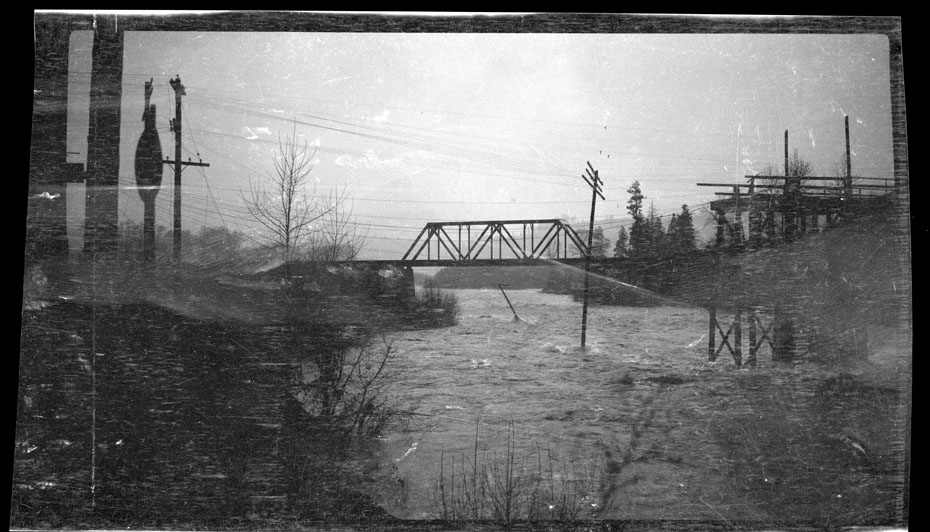
This is one of the earliest of the rediscovered Alva Day negatives, capturing a flood on the Hood River. Another image at the Museum shows similar damage to the old wagon bridge in March 1916. I’m going to assume this is the same event, though I know the old wooden bridge washed out several times before being replaced in 1920.
The negative for this image was terribly underexposed and badly scratched, to the point it almost looked like a blank frame. Fortunately the scanner and then Photoshop give us the ability to recover a good amount of the image. Anyone who has witnessed one of the major floods on the Hood River can fill in the rest– the sounds, sights, and smells of these floods that frequently come after a week of warm heavy rain. It’s not hard to imagine logs battering the bridge supports until the bridge gave way.
As I mentioned Monday, you can help us with the estimated $2000 to process the rest of this photographic treasure trove. Send a check to “The History Museum of Hood River County” at PO Box 781, Hood River, OR 97031 with a note that it’s for photo archives. Questions can be directed to the Museum Director, Connie Nice (phone 541-386-6772). If you include your email address with the check, I’ll send you a special preview of one of the photos you’re helping to preserve and share with the community.
I know this kind of appeal is working for Wikipedia, so hopefully it will work for Historic Hood River. $50 will conserve and digitize 33 of these great negatives, $150 will cover 100 of them. I can’t wait to share the rest of the collection with you, but for now the five we’re posting this week will have to do.

l.e.
I wonder if it is a December flood?
Charlott
It doesn’t appear to be too sturdily built to begin with. Wonder how that pole survived that is in the middle of the river. Looks like some sort of pole in the middle of the river down by the railroad bridge.
Ranger
Looking at the angle of the wires leading to the upper pole, it is possible that the pole is being suspended into the river. Maybe it was attached to the missing portion of the bridge. I can’t imagine that they would set a pole in the middle or even next to the river.
Ellen Dittebrandt
Is it possible that the new cement bridge is seen in the upper left of this photo?
As far as the power pole I have seen them after cars take them out, Some will hang by the wires, I think this could be the case in this photo.
Arthur
Ellen, I think I may be confusing you with how I cropped the photo. You see a solid black border which is the result of scanning "nothing" and then a scratchy black border which is the scan of the part of the negative outside the bounds of the image (ie., unexposed film). Usually I crop out both of these, but I left them in this week as this collection is a work in progress. In fact this negative will be rescanned using a jig I built this week to hold the negative flatter, or we may even do a wet scan to help with the scratches and folds.
Steven Hawley
Is anyone associated with the museum or this website aware of any photos of the Hood River when its confluence with the Columbia was on the west end of town?
Thanks,
Steve
l.e.
Steven: Arthur has a 1930 aerial photo of Hood River, Photograph #72, which shows lowland and a pond west of the HR.
It doesn’t show the river running west, but I can see how at one time the channel could have traveled west before entering the Columbia.
l.e.
Arline Winchell Moore writes that in November of 1915, precipitation fell almost every day. "The old wooden bridge structure over Hood river, east of town, was washed out about the middle of December."
Arthur
In Arline Winchell Moore’s photo album the bridge is described as the bridge that "keeps washing out" so I suspect it happened a few times.
ArthurB
The Hood River Glacier records the "steel bridge" over the Hood River being washed out in December of 1915 and 1917.