
Historic Hood River
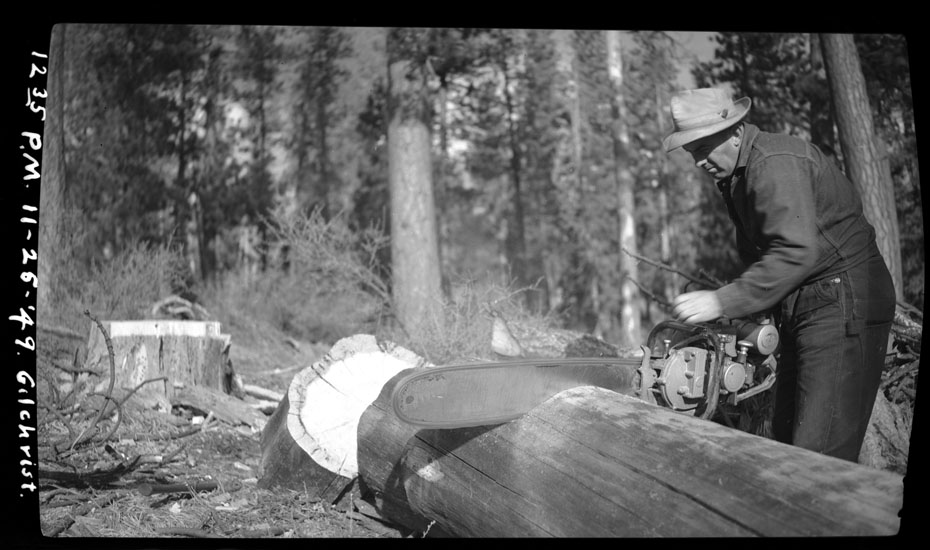
Cutting firewood, November 1949
Notes

The 1949 date for this image makes this is one of the very earliest chainsaws of its type. It was only after WW II that the advent of lightweight gas engines with aluminum parts made it possible to construct a chainsaw that could be operated by a single person. “Gilchrist” probably refers to the logging town in central Oregon.
This photo was taken by Alva Day. We’ve seen a few of his images before, frequently distinguished by his meticulous identification of the date and time of the image. There was this early Mystery Monday (still not definitively solved) as well as this image from the top of Mt. Hood. Imagine my surprise last week when the museum staff rediscovered a large cache of negatives shot by Mr. Day and stored away for decades!
My rough count is that we have about a thousand 3″ x 5″ negatives and hundreds of prints covering the period from 1916 until Mr. Day’s death in 1955. We’re just starting to evaluate this collection and plan for its conservation and digitization, but I spent a few hours sampling its wonders. This week I’ll share five images which hint at the breadth of this collection.
No mystery this Monday, just an appeal. We’ve been digitizing the collection through a generous grant. We planned for some surprises, but nothing on this scale. Just placing the negatives and prints in archival sleeves and scanning them will cost us about $2000.
Historic Hood River viewers can make a donation to the Museum for this project. You can send a check to “The History Museum of Hood River County” at PO Box 781, Hood River, OR 97031 with a note that it’s for photo archives. Questions can be directed to the Museum Director, Connie Nice (phone 541-386-6772). If you include your email with the check, I’ll send you a special preview of one of the photos you’re helping to preserve and share with the community.
I know this kind of appeal is working for Wikipedia, so hopefully it will work for Historic Hood River. $50 will conserve and digitize 33 of these great negatives, $150 will cover 100 of them. I can’t wait to share the rest of the collection with you, but for now the five we’re posting this week will have to do.

Charlott
No doubt a heavy machine
l.e.
My guess is, this is not someone cutting timber for logs but, someone cutting firewood. Or the salesman demonstrating the saw.
He isn’t dirty enough in his clean denims and he is cutting up an old buckskin.
l.e.
The photo was taken this time of year!
Charlott
Yes, he would have had sawdust all over from that huge machine.
His pants look like they just came off the store rack. Definitely cutting for firewood, as he is cutting in rounds to be split.
Charlott
Photogorapher Alva Day came from a large family, with many relatives living in the Hood River area. His wife was Io Stewart.
Arthur
I found a later image from the same day showing a healthy pile of split firewood. Hard to imagine what it was like to prepare a cord of firewood before this invention.
J.E. "Jack" Sheppard
Let’s consider for just a moment: That is an old gear-drive saw which doesn’t throw sawdust like the screamers we use now. They left a pile between the engine and the log that you had to push out of your way to see how close to mother earth you were running the saw chain. Also, if he just started at the stump to his right, he hasn’t been working for that long, maybe four blocks or so. And a guy has to buy new overalls after a while, might as well be now. Fact is, before a day is out he’ll be sweat soaked and dead tired from lugging that saw around, and will in every way resemble a logger!
Buzz
I was told the vibration from those old saws was harder on a man than the packing them around.