
Historic Hood River
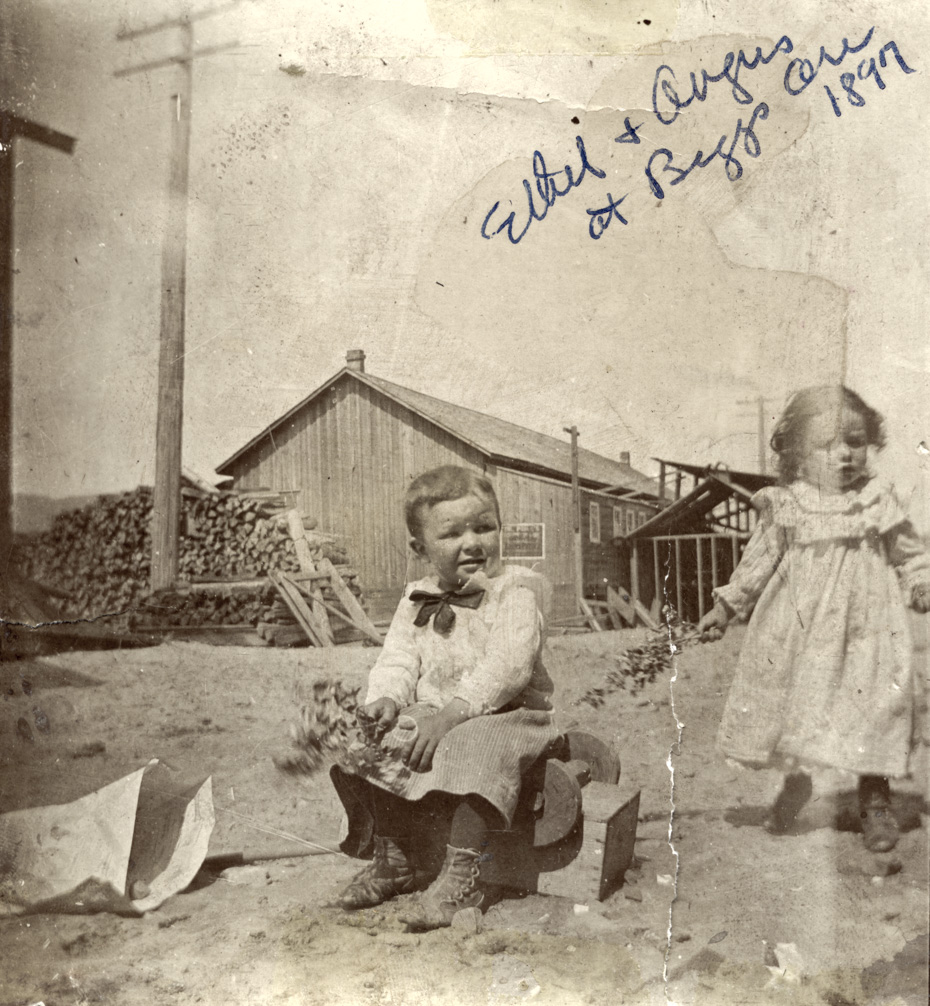
Ethel and Angus at Biggs
3-23-2016
Notes

The caption “Ethel and Angus at Biggs Ore 1897” tells most of the story. Ethel and Angus McDonald were two of the children of Dixon and Nancy McDonald. Based on their 1913 high school graduation pictures, Ethel was 2 and Angus was 3 in this picture.
Dixon McDonald was OR&N Company agent at Biggs. The family relocated from Biggs to Hood River in 1898. They owned a general store, and later Dixon McDonald was later involved with the formation of the First National Bank, and served as mayor of Hood River.

Charlott
Oh dear oh dear!!!!!!!!!!!!!!!!!!! Ethel and Angus were childhood friends of my great-uncles at Biggs.
I have a very instinctive feeling that that is my great-grandfather Clark’s warehouse in the back ground where the grain coming down from Sherman County through Spanish Hollow was stored until it was put on the railroad for Portland and to be milled. McDonald would have had a hand in the grain thing since he was the railroad agent. I don’t know if there were other families living in Biggs, other than the McDonald’s and Clark’s. Nothing really for them to support themselves there.
That huge wood pile there may have been my Grandpa Clark’s wood, waiting to be hauled up to Wasco to the lumber yard that he also owned in this time period.
That is probably the building that housed the first school house in little Biggs. A corner of it was made into a little school type setting for the McDonald and Clark children, and others if there were any. My great-great grandma came via the first ferry run from Columbus to teach this little group. She was an excellent school teacher.
Do you see what little Angus is actually sitting on. Someone, probably his Papa Dixon has made him a little toy cart…..They probably didn’t have a lot of store bought toys up there……….
Charlott
Both Angus and Ethel were born in Biggs. Angus on 4 April 1894 and died 30 October 1958 at the Fort Whipple (veterans hospital) He served in WWI from 3 May 1917 until 30 August 1919.
I don’t know that much about Ethel other than she was born in Biggs in 1896 and died in 1977.
L.E.
Charlott….
I was reading some history about the Columbia River and it mentioned, "The Dalles Rapids", "Celilo Falls" and "Ten Mile Rapids".
Do you know where the "Ten Mile Rapids" were located? Do you remember seeing them?
There is a book titled "The Golden Land" by Giles French. Both the McDonalds and Clarks are mentioned in it. And there is a McDonald’s crossing on the John Day River.
Charlott
The various rapids were many that formed what was called "The Narrows", which started at The Dalles and went up river to Celilo. Ten Mile Rapids would have been a portion of those many rapids closer to Celilo than The Dalles. So no doubt I saw that portion prior to the dam being put in. That was the purpose of the boat canal from The Dalles to Celilo. No way commerial boats could get through that long series of rapids. One needs to keep in mind the width of the boat canal. The boats were nothing like the big things you see moving up and down the river. That boat canal was not all that wide. I don’t know but I would think there was some sort of communication between The Dalles and right up above Celilo where it ended. You could only send one boat through there at a time, as no way was it constructed for any one boat to pass another. I am trying to remember here whether the foot bridge from the highway over to the falls area had to be swung up for the boats to go through. I remember going back and forth over the canal and seeing boats passing, but don’t remember that portion of it. It seems it wasn’t too far from the foot bridge to the water line either. Just wish there was a photo of the canal with a boat in it………..
Charlott
McDonald’s crossing was there long before Dixon McDonald. No connection. In the winter of 1811-1812 another man named McDonald, had been accosted by Indians. They had stripped him of everything, including is clothing, turned him loose to die, but he was rescued by some "nicer" ones and lived to tell the story. The John Day River Crossing called McDonald’s Ford was named for him. It is on the actual Oregon Trail.
Kevin
The Peter Stark book "Astoria" talks in-depth about the Astoria Overland Expedition. I believe it was John Day and Ramey Crook (who had previously been left of dead in Hells Canyon if I remember correctly) that when they got to the mouth of the John Day River, they were robbed of everything and walked barefoot and naked back to the Umatilla. This was in 1812. I can’t find a McDonald as being part of the Astoria Overland Expedition. I wonder if the crossing was named for Archibald McDonald, Hudson Bay Company who ended up on the Columbia in the early 1820s?
spinsur
From: http://tomlaidlaw.com/clickable/macdonald.html
This is McDonald Ford crossing the John Day River which was named for the unfortunate Overland Astorian, who spent the winter of 1811-12 naked in the wilderness after being robbed and stripped by some Indians. A kinder, gentler tribe of Indians rescued him and clothed him. Read all about it in Washington Irving’s Astoria.
"Road lay through a deep, narrow valley, but very barren. At noon camped by a small spring coming out of the valley. (Cedar springs). from here pass over high bluffs and descend a very steep hill to John Day’s river a very rapid stream. No wood here except a few very small willows. All the country from the indian agency to this place is about barren and desolate as any we have passed over and we have seen nothing that could be fairly called wood since we left the Umatilla." (Twin sisters Cecilia Adams and Parthenia Blank, 10/19/1852)
L.E
This topic drifts away from today’s photo, but I think I have to agree with Kevin.
I don’t think there was a naked McDonald wandering around with John Day or a member of the Astor party.
It might take a little more research to find out who McDonald’s Crossing is named for.
L.E
Maybe this.
"The established crossing would change in time, reflecting a growing pattern of settlement east of the Cascades. In 1858, newcomer Tom Scott put in a ferry about a half-mile north of the emigrant ford. In October, 1864, Elizabeth Lee Porter forded the shallow stream and wrote: "Came over a nice road to Mud Springs. A nice day. A ranch house here just put up. 30 miles to The Dalles (Porter 1990: 32). In 1866 Dan Leonard is said to have built a bridge at the site. Leonard’s Bridge reportedly collapsed in 1896 with a rancher from Condon and his heavily loaded wagon teams on it. Around 1904, W.G. "Billy" McDonald and his wife Mattie began operation of a ferry service at the crossing. It remained operational until 1922 when the Columbia River Highway opened (Gilliam County Historical Society, n.d.)."
http://www.nps.gov/parkhistory/online_books/joda/hrs/hrs5.htm
Arthur
I always enjoy watching the discussions these images trigger, I was sure this one would be all about those cute children!
L.E
This must be a later HHR photo of Ethel or Ella McDonald helping raise money for the hospital.
https://www.hoodriverhistorymuseum.org?showimage=602
Arthur…the McDonald Crossing story gets even more interesting. Dan Leonard owned the crossing before W.D. McDonald. He was shot.
Here is the interesting story.
http://www.maryleonardlawsociety.org/who-was-mary-leonard.html
When McDonald owned the ferry, he was conked on the head and another man was shot.
John Freeman Killed and W. G. McDonald Badly Injured in a Three-Cornered Fight….
http://cdnc.ucr.edu/cgi-bin/cdnc?a=d&d=SU19070705.2.17
I can’t find any indication that W.G. McDonald is related to the children in the photo, but the John Day crossing isn’t that far from HR so it is kind of interesting.
Charlott
Ella McDonald Blancher/Moe was very involved in things hospital related and historical as well.
David Denecke
One of my favorite places. We’ve camped there many times. I too forded the river there. In my Landcruiser, August, 2014.
There is stone marker in bushes marking it as Oregon trail crossing site.
Margaret Miller
Ella McD B Moe was Ethel Jane’s older sister.
EJ McD married, Naval Academy graduate, Gerald L Schetky and as the wife of a Naval Officer lived many places. They raised 3 children, all of whom served in WWII. After he retired from the Navy as a Captain, they settled in Rhode Island . She was well known for her knowledge of Dye Plants