Historic Hood River
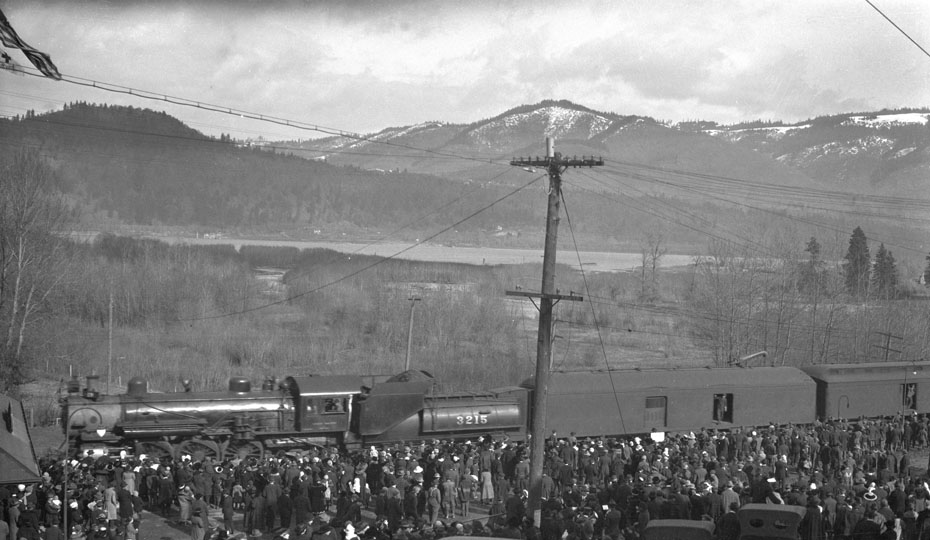
WWI Troop Train
11-11-2015
Notes

Hood River welcoming returning WW I soldiers, February 1919.

The History Museum of Hood River County
Bringing the Rich History of Hood River County to Life
Hood River welcoming returning WW I soldiers, February 1919.

L.E.
Even the railroad cars are bleak looking.
I just did a small write up about Louis Leidl, a young soldier from Klickitat County who is buried in France. For months, his family received reports that he had died in action, then he was alive in a hospital.
In 1923 his parents finally received official word that his grave and remains had been identified.
In 1930 the U.S. military sponsored a WWI Mothers’ Military Pilgrimage. Louis’s mother participated and traveled to France to visit the grave of her son.
L.E.
Looks like the train is using coal for fuel.
Steve r
Nice flag upper left and a bit of snow on the E hills above WS town-
Note it appears the train has just stopped- with everyone facing towards the train in anticipation.
Kenn
The comment about the "bleak" color on the cars made me realize I never saw any color on passenger cars except brown until after WWll, and nothing but "boxcar red" on freight cars. With the exception of air raid concerns in WWll I wonder why.
Dan K
I had two great uncles that might have been on that train. They were from HR and fought in WW1.
LMH
Kenn, for a different perspective on the standpipe location see to the rear of the first railcar.
LMH
Troop trains were not uncommon in those days and Hood River certainly did its part in welcoming troops back home or just passing through. The Canteen Committee of the local Red Cross reported 17 community members in January 1919 distributed 159 boxes of apples along with 54 boxes of home-made candy. The chapter reported spending $250 for supplies for 10,500 soldier, 200 sailors and 50 marines.
This could be a photograph of the train that carried the 65th Artillery coming through Hood River headed for Ft. Lewis for disbanding on February 17, 1919. The Glacier reported some 3,000 people gathered at the station to see them through.
It was a time of great joy and sadness across our nation. The great joy in welcoming home our women and men and grieving for those who did not survive.
You can read all about it ….
http://oregonnews.uoregon.edu/lccn/sn97071110/1919-02-20/ed-1/seq-1/
Arlen Sheldrake
Very fitting photo to honor our veterans Arthur. I wish all our welcome homes were honorable. Thank you.
L.E.
The large pine or fir? trees on the right are interesting because that must mean the area does not flood every year.
That is surprising because it appears to be at water level.
Arlen Sheldrake
The OR&N 197 (UP 3203) located at the Oregon Rail Heritage Center was built in 1905 and did service past HR and was originally a coal burner. It was converted to oil in the 1920s.
Lesa Hanners
The Hood River Glacier – Feb 20, 1919
65TH GREETED BY THOUSANDS – SCHOOLS DISMISSED FOR OCCASION
It is Estimated that 3, 000 Assembled at 0.W. R. & N. Station to Welcome the Returned Artillerymen. The armistice day celebration was eclipsed by that Monday in honor of the two long train loads of handsome and hale Northwestern young men, members of the 65th Artillery. Two hours before the trains arrived fire sirens, school and church bells spread the tidings. Never has such a crowd assembled at the station. All schools were dismissed. It is estimated that 3,000 people lined the tracks. With the band playing and amid deafening shouts the first section rolled in and scarcely had the wheels ceased turning when Richard Scearce, of Battery C, sighting his parents from the car steps, Ieaped into his mother’s arms. All other Hood River boys were aboard the second section. Delayed, this train had orders to pass through Hood River. The officers declared, however, that they did not have the heart to disappoint Hood River parents. In the end, however, it was in many cases a disappointment for the soldiers whose parents had left to join in the celebration in Portland. The soldiers of both sections were given a liberal treat of apples, and friends and relatives of local men loaded them down with boxes of delicacies. "What a fine looking bunch," was the oft repeated expression as the mass of friends and admirers viewed the boys disembarking from the two troop trains. Handsome, trim, neat and husky was every mother’s son of those men of the 65th. "What a difference when we came back," said Roy D. Smith, veteran of the Spanish-American war, who saw service in the Philippines. "Every one of us showed the pallor of ill health. Those fellows seem to be as strong as oxen. No wonder the huns couldn’t stand up against such men." Numerous old veterans of 1861-65 were in the crowd, recalling the days when their regiments came home from the war. There were tears, but tears of gladness, not those that tore the heart like that day on July 29, 1917, when the old 12th Co. pulled out for Fort Stevens. J. H. Fredricy, of the Canteen committee, who had charge of greeting the men, tried in vain to keep the platforms at the station clear of the crowds. After a few minutes the crowds pushed into the cleared spaces and mingled with the returned veterans. When the warm embraces of loved ones were over, the local men were kept busy shaking hands with friends. The soldiers of other northwestern points mingled with the throngs, answering questions and telling of experiences. But not a ghost of a boast was heard. The men of the 65th have simply returned from a duty. There seemed to be a feeling among all the men, however, that the drive on the huns had stopped too soon, that the war should have been carried on into German territory and that some of the conditions imposed on France should have been measured out to the bochies. After brief halts the trains pulled out for Portland, where a reception befitting the record made by the 65th was there tendered the artillerymen. They then went to Camp Lewis, where they expect to be mustered out within the next two weeks. The girls of the Canteen committee of the Red Cross Chapter were kept busy seeing that every soldier had all the apples he could eat. The members of Battery E who were aboard the troop trains were: Capt. Edward W. Van Horn, Carl Copper, Rud lmholz, Paul Lancaster, Allyn Button, Roselle Crone, Fred Thompson, Orville Thompson, Ora Cushman, Albert Miller, Perle Perkins, Gustaf Forsberg, Walter B. Regnell, Ned C. Jackson, Samuel H. Douglass, Corbett Alexander, Delbert Slutz, Everett Swearingen, Earl Dunbar, Gold Dodson and Claude C. Collins. Other Hood River men with the 65th are: Slab Davis, battery D; Jno. W. Allen, Battery F, Richard and Robert Scearce, Battery C, and Edwin Sonnichsen, Headquarters Co. The impromptu ovation to the men was greatly enlivened by the recently reorganized Hood River band, which played popular airs while the trains were here. The members of the band are: C.D. Nickelsen, Harry Connaway, G. W. Ripper, George and Will Zolls, M. P. Warren, J. W. Forbes, M. A. Udelius, Will Davidson, M. Savo, Nelson Emry, Tom Fisher, A. L. Page and Ashley Cash.
The Richard Scearce mentioned here was our grandfather. The Robert Scearce mentioned was his brother.
Kenn
Engine is still slowing and will stop at the water tank to the west during the station stop, eastbound would stop at the standpipe on the right while making a station stop ~