
Historic Hood River
20th Century Truck Farm
Notes

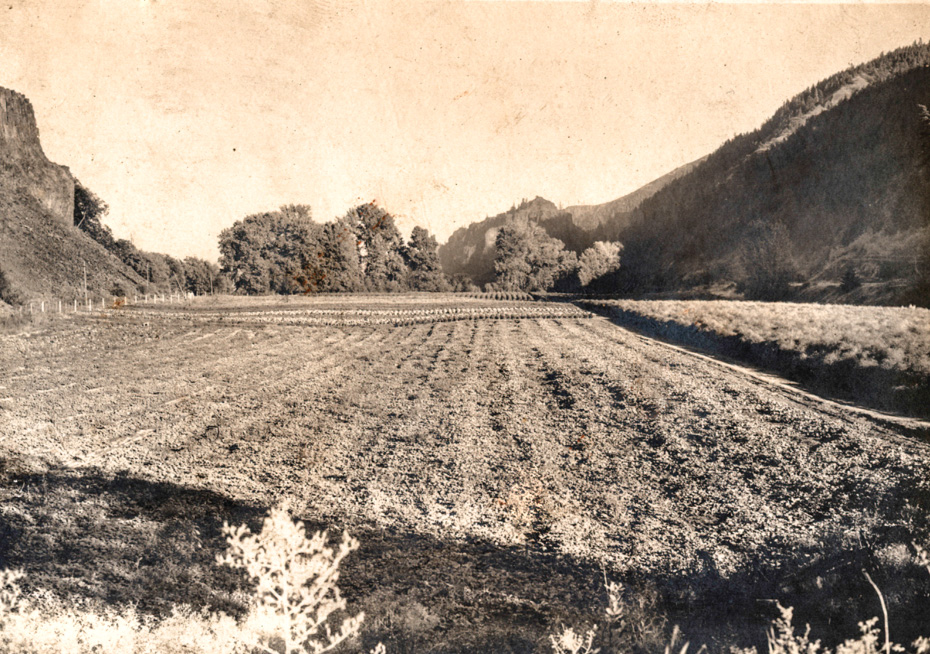
One of the first HHR images was of the asparagus fields at John Koberg’s 20th Century Farm. Here’s another view, along with some additional historic perspective. History is not always pretty pictures. From the May 25, 1922 Hood River Glacier:
KOBERG’S 20TH CENTURY GARDEN BUSY
One of the busiest places in the Hood River valley at the present time is the Twentieth Century Truck Farm, owned by J. H. Koberg, pioneer of the valley, who was an exception to the rule and followed the development of gardens instead of fruits. Mr. Koberg, who has diked in fertile acres along the Columbia east of the city, is now employing 17 people in his gardens. The asparagus season is at its height, and the Twentieth Century, which took the first award at the Panama-Pacific International Exposition at San Francisco in 1915, is forwarding the grass in ton quantities to Northwestern metropolitan centers. The product always demands a premium in the city markets.
Mr. Koberg, one of the leaders in the organization of the Hood River Valley Anti-Asiatic Association, practices what he preaches. All of his help are full blooded Americans. Mr. Koberg is not a believer in the federal free seeds distributed annually by congress men. He says:
“Progressive business men and farmers are always looking for something better. It is especially so with us gardeners, who wish to improve our seed. While we wouldn’t give five cents per pound for Uncle Sam’s free seeds, we have just paid at the rate of $80 per pound for some tomato seed. We have developed a tomato excellent for our purposes, calling it the Hood River Special. If we can secure a tomato that will ripen 10 days or two weeks earlier and still retain its quality, we will have a gold mine. We have secured some highly developed foreign seeds, which we have mixed with ours this year. These are being distributed among our city garden friends.”
In order to increase an interest among the vacant lot gardeners, Mr. Koberg has offered a prize of $2.50 for the season’s first ripe tomato grown from his plants.

charlott
Bet that was some of the best aparagus ever grown. Shows right up through where 84 goes. Has to be Stanley Rock there on the left. Those posts along there are located, I would think, about where the rest stop is now.
l.e.
The "Anti-Asiatic Association" does not surprise me, but I have never heard of the "federal free seeds" distribution.
Buzz
Interesting. I wonder if his full blooded American help included Indians.
Melody Shellman
And now it’s an in-lieu fishing site. Full-blooded Americans indeed.
charlott
I think the Indians did work for him, as their little community was just up the hill from this location.
Arthur
It probably bears mentioning that Mr. Koberg was born in Germany.
Arlen Sheldrake
Build our railroads but don’t pick my asparagus…..no wonder our actions following Pearl Harbor were so "easy". Born in Germany sure makes one a "full blooded American"…….we sure have a lot of interesting history and thanks Arthur for keeping our history alive.
Kenn
Do people still dive off Stanley Rock as in the old photos?
Jill
Asparagus is grass? Why did I not know this? I like your remark Arlen about building the railroads but not picking the asparagus.
Jeffrey Bryant
Here is an article from 1906 saying J. H. Koberg would go into Truck Gardening business, planting asparagus.
http://oregonnews.uoregon.edu/lccn/sn97071110/1906-02-22/ed-1/seq-3/
syrus
that must have taken a long time to plant
L.E.
The June 9, 1913 Oregonian page 12, says flood waters have damaged orchards and dock. F. H. Button’s pear orchard is submerged and J.H. Koberg’s asparagus beds and greenhouse have been damaged. The White Salmon dock has been damaged.