
Historic Hood River
Hood River Street Traffic
9-3-2013
Notes

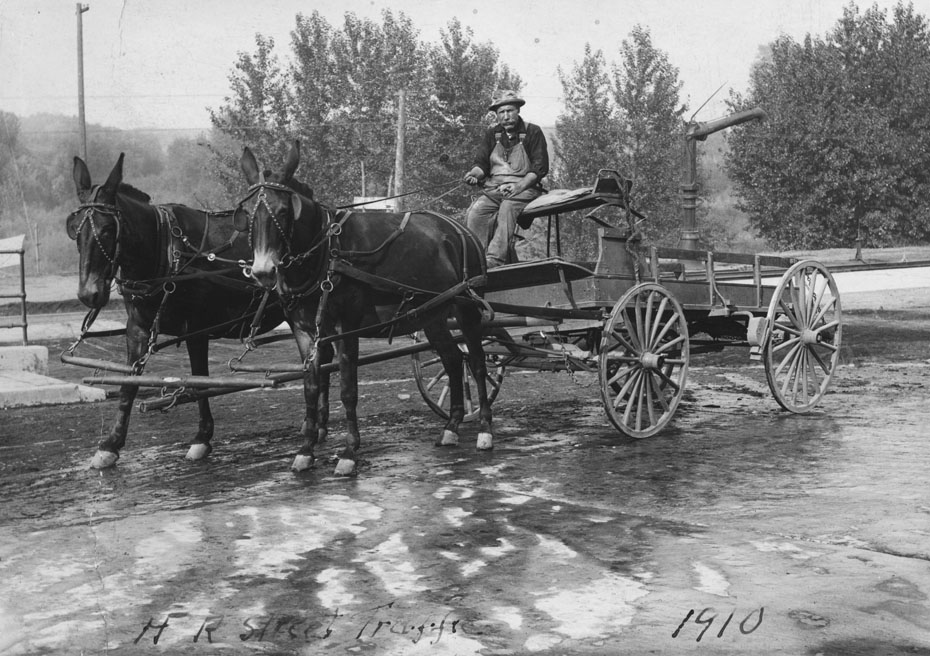
This postcard of “Hood River Street Traffic” shows Isaac Ford down by the train station in 1910. OK, I’m a city boy, so I’m going to say those are mules? I’m sure I’ll be corrected quickly if I’m wrong.

charlott
Definitely mules……..they were more durable than horses. He was a wagoneer for the train, so makes sense why this is down at the area of the depot.
Isaac Ford came to Hood River from Canada where he was born.
Rawhyde
What a great shot. Driving the team with his stogey in his hand. And check out those breaks, frightening.
dsc
The wagon has quite a "list" with just the driver on board…tired or worn-out wagon suspension seems to be the case.
l.e.
Beautiful pair of mules. I like the stogie.
The street looks icy, but it must be spring time. The leaves on the trees look small as if they have just leafed out.
And what is the post behind the wagon. Is that what you hung the mail sack on?
Judy
To me the post behind the wagon looks like it has a tube connected to it for water.
Arthur
As I understand it, the water tank at the end of Second Street was connected to that apparatus which would refill the water tanks of the steam locomotives. I’m not sure if it shared the water source that fed the refrigeration in the Union Building, if it was on city water, or if it had it’s own source.
l.e.
I wondered about water, but didn’t think it was high enough.
Sometime it would be interesting to find the location of the different springs in the HR area.
Several photos of the older homes mention a spring. Of course the one at the Coe’s. The Blythe place mentioned a spring and Dr. Adams’ Paradise Farm mentioned one.
nels
Nice pair. And they look well taken care of. But those brakes? That must have been a very important issue in delivering from the waterfront or train up to the
homes and businesses in Hood River..
longshot
What is the helical like thing handing off the left of the seat? A cane?
longshot
Pretty light looking wheels, that wagon wasn’t designed for heavy hauling.
Jeffrey Bryant
The springs that I am familiar with are as follows:
One that starts in Jackson Park and runs behind the houses on the west side of 13th street through Paradise Farm. My Vaughan family lived on 13th. My great-grandfather, Robert Vaughan, showed me how to find periwinkles when I was very young.
One that starts below the old Hood River Memorial Hospital. It runs down the west side of 13th street and through the park at the west end of State Street. We used to fish for trout and catch crawdads in the park. The Indians camped below the hospital, across from the Vaughan’s. My great-great grandma Vaughan would give them food.
One that started at the springhouse on the Coe property. The Coe springhouse was still there in the 1970’s, and was probably the oldest structure in the valley. We would find bones that were most likely from cattle that died the first winter of white man occupation in the valley. We spent a lot of time at this spring, digging for worms, catching crawdads, and getting dirty.
There was also a small frog pond behind the church above Park Street School, and another one in the gravel pit above the LDS Church. Of course, boys and frogs went together. I don’t know of any outlet for these ponds.
Buzz
Do kids still catch crawdads? They were good eating.
l.e.
Thanks Jeffrey. Very interesting. But, does the one below the old hospital run down the west or east side of 13th street?
I’m surprised it was big enough you could catch fish.
That whole hill side must be bubbling with water.
Yes Buzz, I think kids still catch crawdads if they live in the right areas that are still country.
Jeffrey Bryant
The one below the hospital runs down the east side of 13th.
l.e.
Jeffrey…just wanted you to know that today I drove slowly UP 13th and then I drove slowly down 13th and then I took a couple of side streets off of 13th.
All for the purpose of checking out those creeks that I had never paid much attention to.
Jeffrey Bryant
Access to the springs was best at the park at the end of State street, up the driveway that led to Sab Akiyama’s house and behind the Vaughan houses, and at the Coe house (the Wells family lived there when I was growing up).
Charlott
Now we had a creek on our Pine Grove property and did see crawdads in the first few years of living there, then no more. Spray naturally went into the creek from spraying orchards along it. My Dad said he figured that that might have had something to do with them disappearing. I have not seen a crawdad around here in years. Now living in Sherwood for 20+ plus years the creek was full. Dick would take our daughter down to catch them. Had a crab pot and put an open can of dog food and what a catch. She caught the biggest one in a Robin Hood Festival Derby for kids using this method.
Jeffrey Bryant
There weren’t many trout, but we caught keepers at the end of State street. People would laugh at us when they saw us with our fishing poles. But we enjoyed the fish just the same.
Cyrus Vaughan was selling strawberry plants in 1902. They grew strawberries where the High School track and football field were. I don’t know if the spring was used for irrigation or not.
Bill P.
All right you "craw dadders", the best were always caught in Lost Lake. In the 1970’s I helped map all the known old and new springs in the City with the city engineer. Hopefully these are filed some where in the archives. Many I remember as being joined by a common creek. These springs are the outlflow from the Valley from East Third Street to Country Club Road into the Columia River.
Bill P.