
Historic Hood River
Scapegoat
4-18-2011
Notes

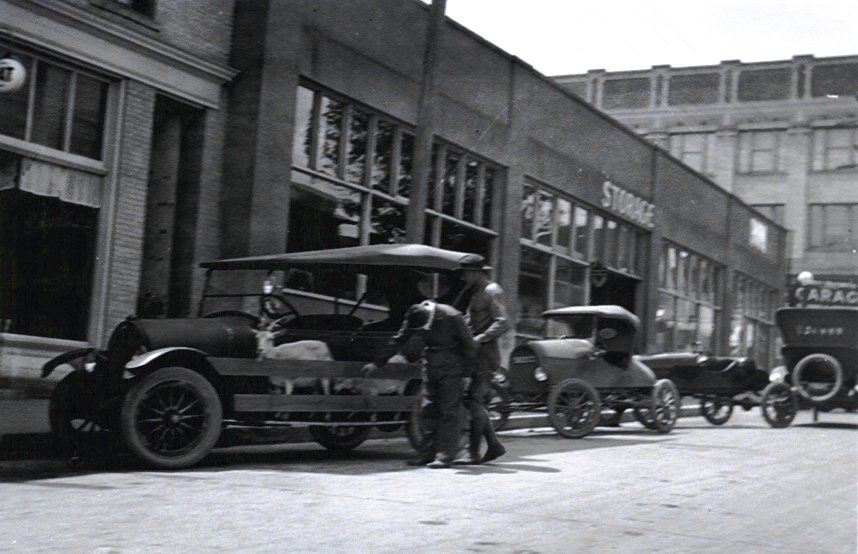
215 Cascade now houses the Columbia Center for the Arts, but when this photo was taken between 1915 and 1920 it was a garage and storage facility. There must be a very good story behind this image, but it is unfortunately lost to history. We can only guess why the goats were visiting downtown or what those men are doing. If you can ID the automobiles or have any insight into this photo, please add a comment.
Here’s the same spot today.
With this image we’re inaugurating “Mystery Monday” at Historic Hood River. Each Monday we’ll post an image which raises questions: sometimes questions which someone out there might be able to answer, or sometimes (like today) questions which can only be met with speculation.

l.e.
I think those might be sheared sheep which means it is spring time. Might be ewes with lambs that someone is selling.
l.e.
And I’m not so sure that the second animal isn’t a calf. It gets pretty blurry when I enlarge.
Probably the little boy belongs to the car. I would imagine that in those days you didn’t climb on someone else’s car.
Is that a cafe window in front of the car?
db
No, definitely a goat. Look at the beard. But you’re right, the second one might be a calf. Looks a bit like a Jersey. My guess is that somebody brought them in to town as a sale and the exchange is taking place. That’s a clever way to transport small animals, back in the day of running boards.
Arthur
The building next door is the Hotel Oregon. It had a cafe, though other pictures show it on the east side. In recent years the east side had a restaurant (remember Rio Grande?) as well as this north side space.
Dr. Steelhead Catcher
Before the Fuller Brush man, there was the Goat salesman…have goat, will deliver to your door step.
db
In the day before everyone had a car, being able to make the delivery might have meant delivering the sale.
db
That’s actually a pretty nice looking milk goat. Perhaps she won a ribbon at the County Fair and the photo is to honor her accomplishment.
Jim Gray
From the look of the goat car I am wondering maybe late twenty’s instead, it looks well used. Speedster bodies were a common aftermarket purchase for the next two cars, darn hot rodding kids, that would put a few years on Model T’s, they would be old enough and cheap enough by then for young hoodlem’s to afford a car.
l.e.
Well you know goats db and I can barely see the beard so I will take your word for it.
I was wondering about all of the cars in the picture. Was the Columbia R. Highway the only way into HR by auto? I think it was completed in 1916 Were there cars here before that? Did people bring cars in by train or boat and then drive them around or as soon as the highway opened up did people go to Portland, buy a car and drive it to HR.
Arthur
Jim’s made a good challenge of the date. The image is from the Davidson Collection which is in our database as "1915-1920." I’ve been able to date several photos externally, between 1912 and 1918. Unfortunately the license plate is blurry, but the pattern of numbers seems to be the one Oregon started using in 1920 and continued for the decade. I’ll try to check the date that building was constructed.
Larry
My brother-in-law, who works at the National Automobile Museum in Reno, confirms Jim’s observation that the middle two cars are Model T’s, with aftermarket Speedster modifications. He’s still trying to figure out the other vehicles, and I’ll post in here if/when he does. No additional info on the date of the photo, though.
Barbara Parsons
Speaking of "door-to-door goats", do you have any photos of Hood River kids in a goat-cart? In the town where I live now, many family albums contain at least one photo taken by an itinerant photographer with a goat and cart.