
Historic Hood River
Stanley Smith Lumber Co. Greenpoint Mill
4-28-2014
Notes

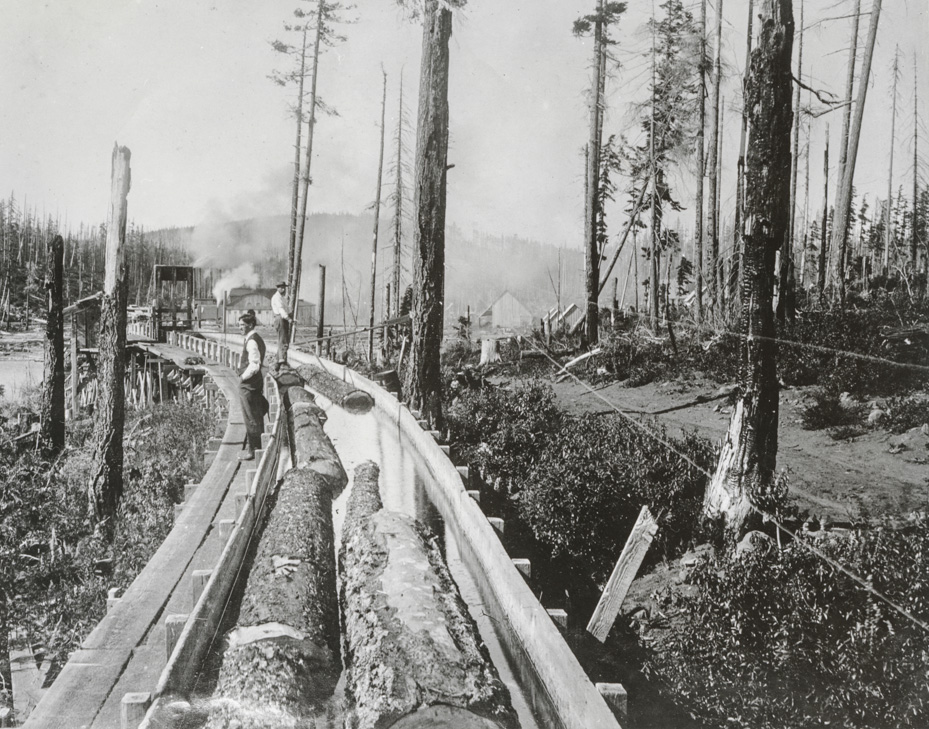
Two weeks ago we saw a logging operation at Greenpoint. Here’s the Stanley Smith Lumber Company’s Greenpoint Mill, which probably received those logs. The company also had a planing mill (which we will see tomorrow).
Does anyone know where the flume originated, or if any sign of it remains?
This image is dated 1916.

Charlott
Haven’t a clue as to answers to the questions. Maybe some of the guys living in Oak Grove, who have farm land down below, or possibly have hunted in years past up in those woods would know if they ever saw anything.
I don’t know that much about logging, but unlike a lot of old flumes I have seen, this one seems to go along, at least at this point, pretty flat. This makes me think that the men would have to sort of urge the logs along.
I have a question and Buzz seems to know a lot about this particular industry. How deep would that flume probably have been. I know that it doesn’t take much water to make things float. Drive down the Columbia River Gorge in a "monsoon" and you will find out……..
charlott
Stanley and Smith bought this mill from Davenport. The had lumber all over the place. They had a retail business on Belmont, whole sale lumber yard down on the railroad.
This mill put out approximately 150,000 board feet of lumber per day.
Due to weather there was about a 2 month period in the winter they they closed down.
l.e.
I wonder what the barb wire was for?
This photo was almost a hundred years ago. The landscape has probably changed a lot.
Buzz
Flumes have always interested me, but I am a complete novice as to their engineering and application as they were no longer in use where I lived and worked. I would guess their depth would be determined by size of wood being transported–small boards up to big logs. I can’t imagine a flume being engineered so level that manpower would be needed to push it along. The water is obviously slow moving here, but as a guess I would think this man would be using his pike pole to ensure that no logs would get jammed up in this particular curve.
l.e.
Maybe this is why we see burned tree trunks.
From a 1914 insurance booklet:
"Hood River-The large sawmill of the Stanley Smith Lumber Co at Green Point burned to the ground August 13th It was a double side mill of 125,000 feet per day capacity The plant was insured for approximately $60,000 The fire is supposed to have originated from a flying spark from a forest fire loss $120,000 JE Robertson is local manager"
From the 1915 St. Louis Lumberman:
"The lumber industry of the Hood River valley in Oregon is beginning to show signs of revival The new plant of the Stanley Smith Lumber Co at Greenpoint is expected to start operations soon This plant replaced a large mill which was destroyed by a forest fire last August It has a capacity of approximately 80,000 feet per day The Stanley Smith Company have two plants located in the lower valley which will be operated this season"
l.e.
I don’t know if any of you have seen this History Timeline. It is kind of interesting and there is quite a bit of lumber and mill information in it.
http://www.tiki-toki.com/timeline/entry/154215/Columbia-River-Gorge-and-Mount-Hood-Timeline
Anyway, in 1917 Stanley Smith flume and mill burned at Ruthton and Greenpoint.
Ellen Dittebrandt
The Creek running at the bottom of Post canyon is Called Flume Creek.
Chase
I see at least one person found my timeline. I have copies of old maps with many of the flumes on them that I got at the state archives in Salem last year. One of these days I want to make a large and accurate map of all the flumes (that I can find) and the dates/mills/other info for the whole Gorge.
Please email me if you want to exchange information on this. Thanks,
Chase
chasinghistory.org
moonlight.on.vermont@gmail.com
Longshot
You can see a gate on the flume up ahead which probably kept the logs back, but let water through. It must have backed up the water a bit though. A log flume is going to be much deeper than a board flume, and I would think the maximum gradient for a log flume would have to be substantially less as well. I wonder what the largest log this flume could handle was?
l.e.
Hello Chase!! What a pleasant surprise.
I did not expect to meet the organizer of that site here.
A map of all the flumes would be fascinating. Where I grew up in the Camas/Washougal area, there was a flume that brought logs from way out in the hills, to the paper mill in Camas.
When I travel that area I wonder how they ever thought they could get logs to float from point A to point B. over hills. The flume burned in one of the Yacolt Burns.
l.e.
The link below has an explanation of the Stanley-Smith mills and flumes and how they worked.
http://homepages.rootsweb.ancestry.com/~westklic/ssmills.html
Ellen Dittebrandt
Thank you Chase I spent all day reading your time line.
l.e.
The April 25th, 1918 Hood River Glacier on page 8 has a for sale add for the Green Point Mill.
There is a good description of the mill, flume, water rights etc.
Jeffrey Bryant
An excellent article describing transporting logs in the Stanley-Smith Lumber Company log flume can be found in the September 9, 1909 Hood River Glacier, page 6 at:
http://oregonnews.uoregon.edu/lccn/sn97071110/1909-09-09/ed-1/seq-6/