Historic Hood River
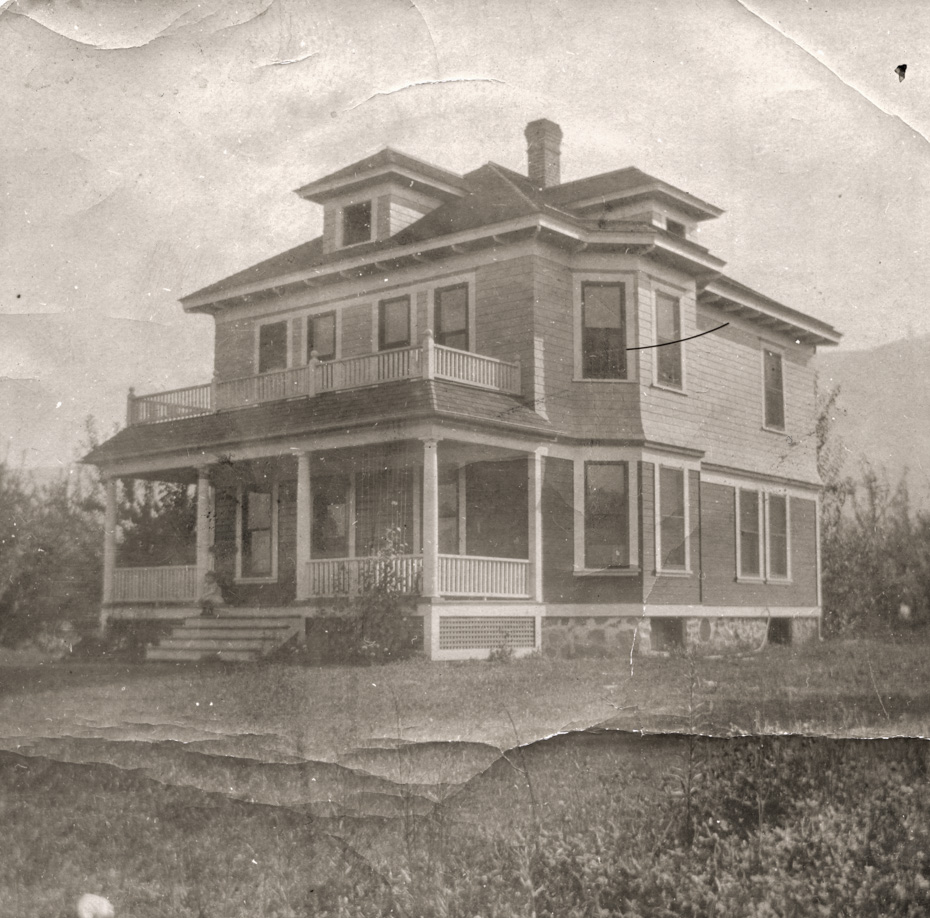
Lucius Clark Home
4-29-2016
Notes

This beautiful house is identified as the Lucius Clark home in Pine Grove.

The History Museum of Hood River County
Bringing the Rich History of Hood River County to Life
This beautiful house is identified as the Lucius Clark home in Pine Grove.

Charlott
Oh my goodness………………..This definitely was the home that my great-grandpa Clark built in about 1903, as the family moved down from Wasco in 1904. I don’t know the exact date of this photo, but it is an early one, apparently soon after its construction. Eventually he would build a long uncovered porch on this side closest to us. On the north side would be a beautiful drive through portico. On the back, which would be the east side a porch would be built along the entire side with glass windows from floor to ceiling.
First floor, you entered off the front porch into a foyer where stairs went up. Parlor where bay window is, with dining room to the east. Kitchen was in the northeast corner.
Second floor, master bedroom with bay window, plus three other bedrooms and full bath.
Full attic and what a wonderful place. When I was a little girl my great-aunt Florence (Clark) Thrane let me build my own personal play house up in that front dormer. Another aunt lived across the road and I could spy on her from there and though I hadn’t seen her that day could later tell her what she was wearing and what she was doing. She never could figure out how I knew all those things until many years later.
A remarkably built home and years and years of love and memories connected with it….
Sadly this house burnt when Bernie Wertgren had the property. I actually stood and watched this greatly treasured home burn to the ground that night.
Kenn
Beautiful home, thanks for sharing your descriptions and memories. Obviously a man of means, I would guess he was involved with orchards or lumber.
Charlott
He had had many business ventures. He initially was at Biggs, where he was the first postmaster, owned the ferry and had the grain receivership from Sherman County. He then went to Wasco where he owned and operated Union Lumber, while still owning the ferry. Went into partnership with 3 others and built Wasco Milling, only to have the railroad punched in to make it cheaper to ship wheat to Portland than have it milled locally. Purchased the 160 acres in Pine Grove and from about 1902 until after 1904 floated between Union Lumber and setting up his orchard and building his home. He sold Union Lumber and farmed, but in later life wintered in Long Beach, where he found another profitable endeavor, the newly found oil off Long Beach. He had grown up in severe poverty and said very early in life his family would not know the terrible trials he had had in his youth. Very true to his word.
Marilyn
Yes, a really beautiful house. Wonderful history. I wish I knew as much about my family as you do yours. What an enterprising man he was.
Arlen Sheldrake
and who might that be sitting on the porch steps? love the front porch…hate the recent trend to put everything in the back yard and wall off the street side…
Charlott
I have numerous photos of the family over the years sitting on the steps of that porch or in the swing that was hung eventually under the living room window.
Charlott
I didn’t even notice anyone sitting on the porch step. That would have to have been my great-aunt Gladys Clark.
Arthur
I tried to zoom into the original to see great aunt Gladys, but unfortunately the focus is very poor. Her face is completely obscured. We do, however, have a wonderful photo of her as a young woman with a branch of apple blossoms. I’ll put it up next week.
L.E.
What a beautiful home Charlott. Your great grandpa had good taste in design and some admirable carpentry skills. Sorry it burned.
I have been attending a conference on the Volga Germans, a group of people who kept close family ties and links to their history. They were a hard working people who suffered through wars and famines and knew what poverty was.
Life still wasn’t easy when they came to the U.S. but they continued to prosper, and as your grandfather said, their children did not have to suffer the hunger and poverty that they did.
This country might have its faults, but it allowed a poor man to work, improve his life and build a beautiful home like this one.
L.E.
Speaking of poverty, the expression "dirt poor" was discussed at the conference.
I have always thought of it as a "poor farmer" who worked and struggled in the dirt.
But there is this aspect of it.
Dirt poor could mean, they did not own their own land. Dirt was valuable and the better the dirt, the more valuable.
If you worked the land for someone else, such as a king, you were dirt poor.
Peasants were hungry for their own "dirt" Early settlers to America were looking for their own "dirt". The Oklahoma Rush was a race to own their own dirt and a race to get the best dirt.
If you owned your own dirt you could work to make something of yourself and the better your dirt, the better your crops. Willamette Valley farmers were generally not "dirt poor".
Charlott’s great grandfather probably had "good dirt" and it was his own. It got even better with irrigation.
Arlen Sheldrake
the single visible chimney has me curious…..was there some sort of central heating used in this home and what did it burn? a recent conversation with Pete Jubitz he mentioned that the Franz Hardware building in downtown HR was originally heated with a coal and he still had the something like 8′ stoker rod that was used to drag the kinklers out
Charlott
You know I have always wondered why there were no fireplaces in this house. Yes, it did have central heating. It was always heated by wood, until in about the mid-1950’s. Many people converted to oil furnaces in the area, but why my great-uncle went to saw dust is beyond me. That may have been one of the factors involved when that house burned that night as there was saw dust in the basement. I saw it go up in flames so fast. It was a cold night with about 2 to 2 and 1/2 feet of snow on the ground. Fire department had a horrible time getting there, and by the time they did it was gone.
Also, now that I think it through that child on the porch is probably not Gladys, but Florence. Florence was born in 1900 and she looks to be about the right age. I think she is too small to be Gladys who was 4 years older.
Buzz
Arlen, I thought they were called "clunkers. Are kinklers something different?
Charlott
Clinkers are what you shake down from a coal fire…
Shirley Clark Fisher
What a beautiful house! Arista Clark built one simular but much plainer in Kalkaska Mi. I grew up in that house my g. Grandfather built. strange the Clark’s would be in the same type of work. Lumber. Shirley Fisher
Charlott
Yes our Clark relatives all seemed to have a love of quality homes.
Jean Dobkowski
I am Lucius Bliss Clarks ‘ granddaughter. My mother is Marguerite Clark Ordway. I remember the house in Pine Grove but was never in it. I remember the Trane house and the Wells just down the street. Aunt Florence gave me a china tea set when I was about 8. I still have it . She said it had been hers when she was young.