
Historic Hood River
Hood River Marina
7-2-2014
Notes

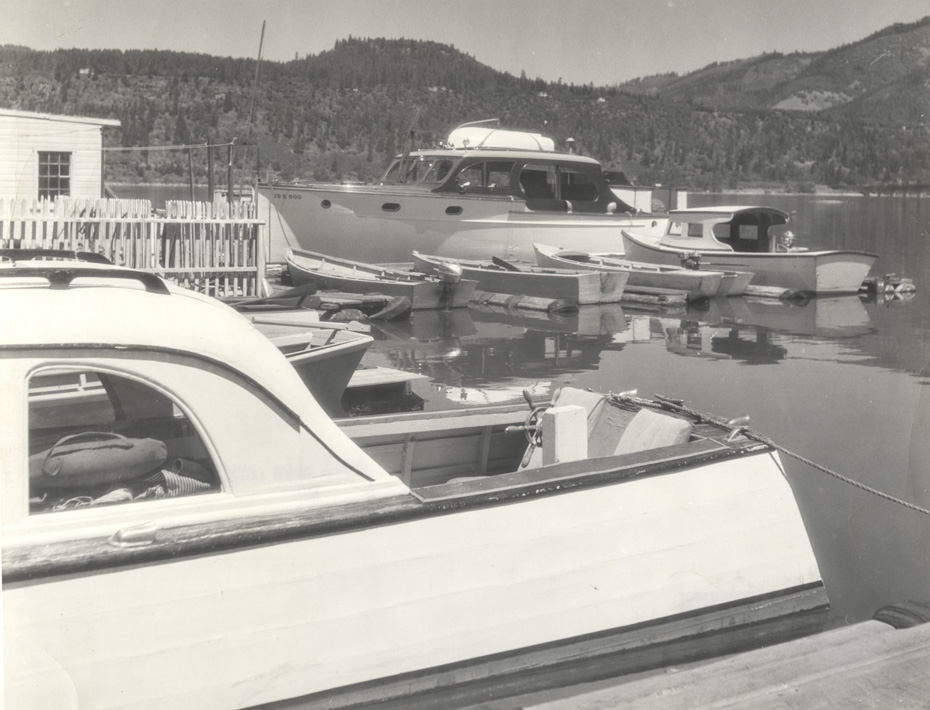
The location is clear, but when was this taken? The best I can do is place it between the 1940s when docks were placed at the mouth of the Hood River (after Bonneville Dam construction) until 1962 when the boat basin was built around this spot.

Buzz
Looks like another good day for water-skiing in the late 50’s.
Jill
No wind?
I agree with Buzz –sure looks like the boats we used to putter around in on Lake Washington in the 50’s.
Buzz
I have wondered if the wind blows more now than it did during the 50’s. We had some days when we couldn’t ski, but my memory is that we were able to ski more days than not. And I remember a lot of days that looked like this picture. Mary, Jane, Charlotte, or anybody, does the wind blow more now??
Judy
I have lived here only 50 years, but it sure seems like the wind blows more now than it did in the 60’s Maybe I was just too busy to notice.
Kenn
The wind is a welcome breath of gold on Hood River.
Buzz
And hopefully the river will stay clean enough for many more years so people can continue to enjoy that breath of gold. I will settle for just being able to eat the fish and crab on this end.
Charlott
I don’t recall that it did. I think with the windsurfing we are more aware of wind now.
I always chuckle about one day driving up the Gorge at Hood River, just when the windsurfing thing was really taking off. All of a sudden my husband said, "all those years sitting there whining because the wind is blowing and we can’t water ski. If I had of taken my Mom’s ironing board, hooked a sheet to it, I could be a millionaire now, having started the wind surfing industry. Leave it to Jones..
Steve r
I spy the tiller of a sail boat- the "spit" of a island- and so few homes on the WS bluff- Oh and a dingy on the roof of the bigger boat.
Arlen Sheldrake
my memory is that the wind ALWAYS blew we just didn’t know it had value
l.e.
I think the wind ALWAYS blew.
In the early days, lumber and cordwood were sailed from Stevenson to The Dalles on sailing scows.
Eph Winans in his memoirs, says:
"Every little landing seemed to have a wood producer and there were various little mills scattered along the river.
Most of the boats that plied the river were single-masted sloops. The Underwood brothers, Captain Amos and Captain Ed, had the only two-masted scow of the river.
There was one boat which sailed up and down the river by the Teo brothers, who had come from Hawaii and who were remarkable singers. Drifting back from The Dalles downriver at night, one could often hear their fine singing in the native tongue.
When windy weather would come up on the river as it often did, and the scows couldn’t properly tack against it, the sailors used what is called a drag sail, consisted of a round pole, five or six inches in diameter, on which was hung a heavy piece of sail cloth. The pole was weighted at either end and connected to the scow by lines. This drag was heaved over the bow when the boat was out in the river’s current and the current pushing against this drag sail would propel the boat downstream.
As many as five men were required to handle the bigger vessels. Generally it would take in the neighborhood of 10 hours to run from Stevenson to The Dalles, a distance of around 40 miles."
Arthur
Lewis and Clark mention the wind, McLaughlin mentioned the wind, Eph Winans mentioned the wind– I think it’s been blowing here for a long time.