
Historic Hood River
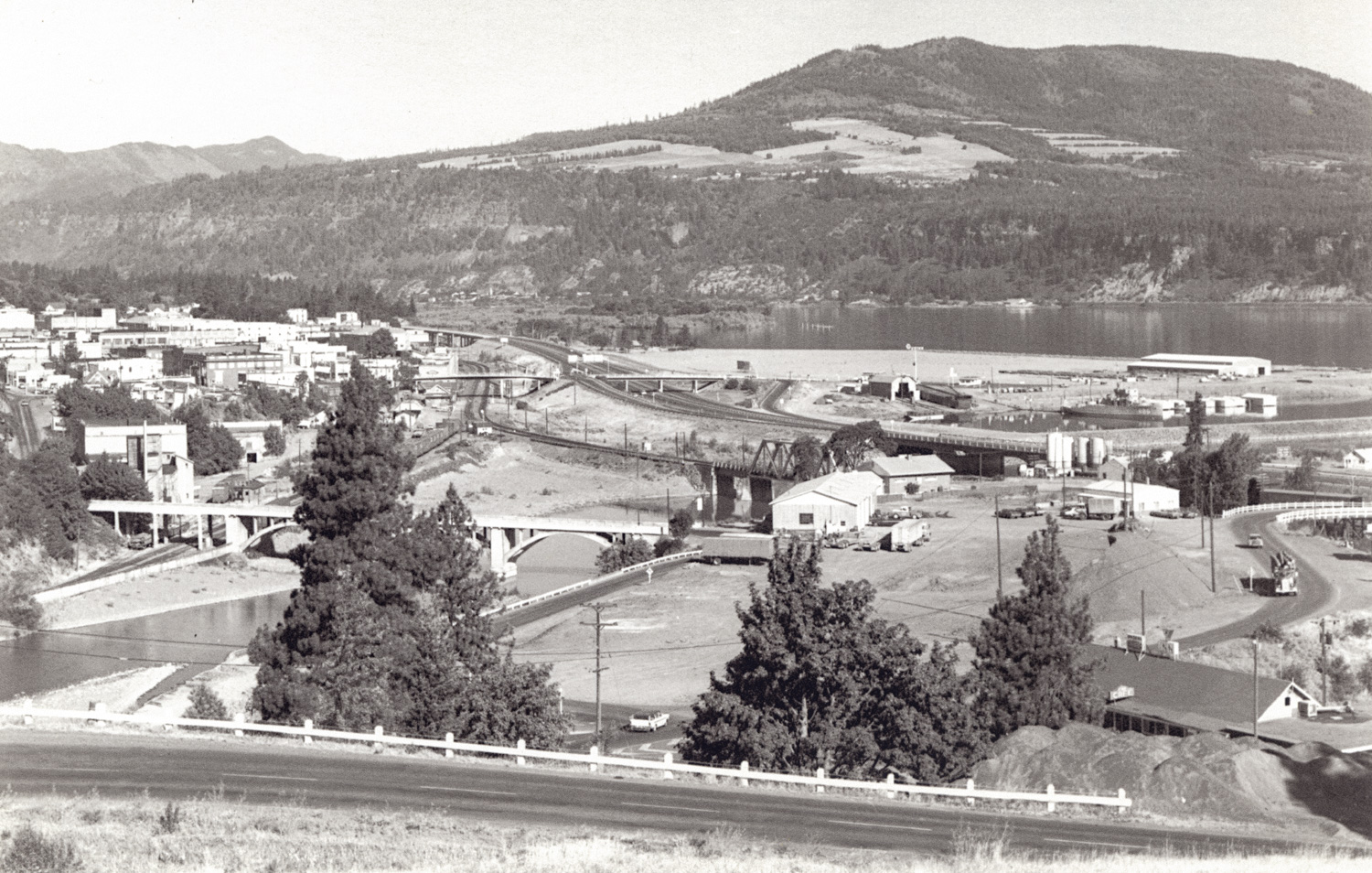
Button Junction, circa 1967
10-27-2025
Notes
This is a good view of “Button Junction” (the intersection of State Street/ Columbia River Highway and Button Bridge Road/ SR35) from the late 1960s. You can see the building which now houses “Windance” as well as the old Button house, though it has lost its upper level. There is an empty lot where Tum-a-lum is now located. The site of Grace Su’s China Gorge (now Hindustani) has a sign which says “Cafe”. You can also see the beginning of the Button Bridge which crosses the railroad tracks on the way down to the interstate.
In the Port area you can see the Nichols Boatworks as well as the other buildings we were discussing last week.

Peter Harman
It’s amazing to compare this image with the circa 1924 image (https://www.hoodriverhistorymuseum.org/hood-river-circa-1924/)
In this image there is a big pile of gravel where the hill that the old blockhouse stood upon used to be. I think the last images I’ve seen of the blockhouse are from the 1940s
Arthur Babitz
Peter, this is the latest image I can find of the blockhouse: https://www.hoodriverhistorymuseum.org/button-junction/
I’ll have to look a little more carefully later.
Peter
I’ve been pondering this and attempting to research it for a few years. Unlike the blockhouse at Cascade Locks (a center of the action in the 1856 conflict) and the White Salmon blockhouse placed on the Joslyn farm after the 1856 conflict (apparently placed in a manner that cut it off from the mainland at high water), I can find no reference to a Hood River blockhouse anywhere except on this site. And considering that a blockhouse would be used as a place of refuge by regular people during a conflict, I think this would be a terrible location (on the other side of the river from town, and ostensibly constructed before there was a bridge across the Hood River).
Is it possible that this wasn’t a defensive blockhouse, but something else entirely, like a water tower? Maybe fed by a pump (or possibly a piped spring from the hillside above) and serving the Button Farm from the slight rise on which it sits? The fact that I can’t find any mention anywhere of a Hood River blockhouse has me wondering.
Jeffrey Bryant
The Button Bridge did not last much longer. My Dad used wooden beams from it when he built the Hood River Nursery building in 1972.
Jeffrey Bryant
The blockhouse possibly could have been located there because of the Indian Allotment land just to the East.
Arthur Babitz
Peter, I’ve been skeptical about the blockhouse story too, but Bill Pattison shared it with confidence and he was a pretty reliable source.
Peter
From a description of the construction of the Frank Button house in the Hood River Glacier, August 20, 1903:
Mr. Button will have every modern convenience about his dwelling. Hot and cold water go to all parts of the house. Heat will be supplied by a furnace. The interior finish will be particularly fine, the plaster being enameled with six coats of paint. In extent the house is 33×42. There are three stairways, and bath rooms are to be found on both floors. // On the hill back of his house Mr. Button has placed a 4.000-gallon tank, supplied with water pumped from Hood river by a Samson wind mill bought of Frank Davidson. The bottom of the tank is 15 feet above the roof of his house and furnishes a 50 foot pressure.//
Looks like it is a water tank