
Historic Hood River
Dry Town
Notes
In March of 1895 the newly incorporated Hood River city council met to start the work of doing all the things necessary to create a new governing body, as well as to pass some rules governing the behavior of the residents of the town. Letters in The Hood River Glacier leading up to the incorporation vote made it clear the vote was a battle between people eager to impose rules and organization and those eager to maintain their free-wheeling ways.
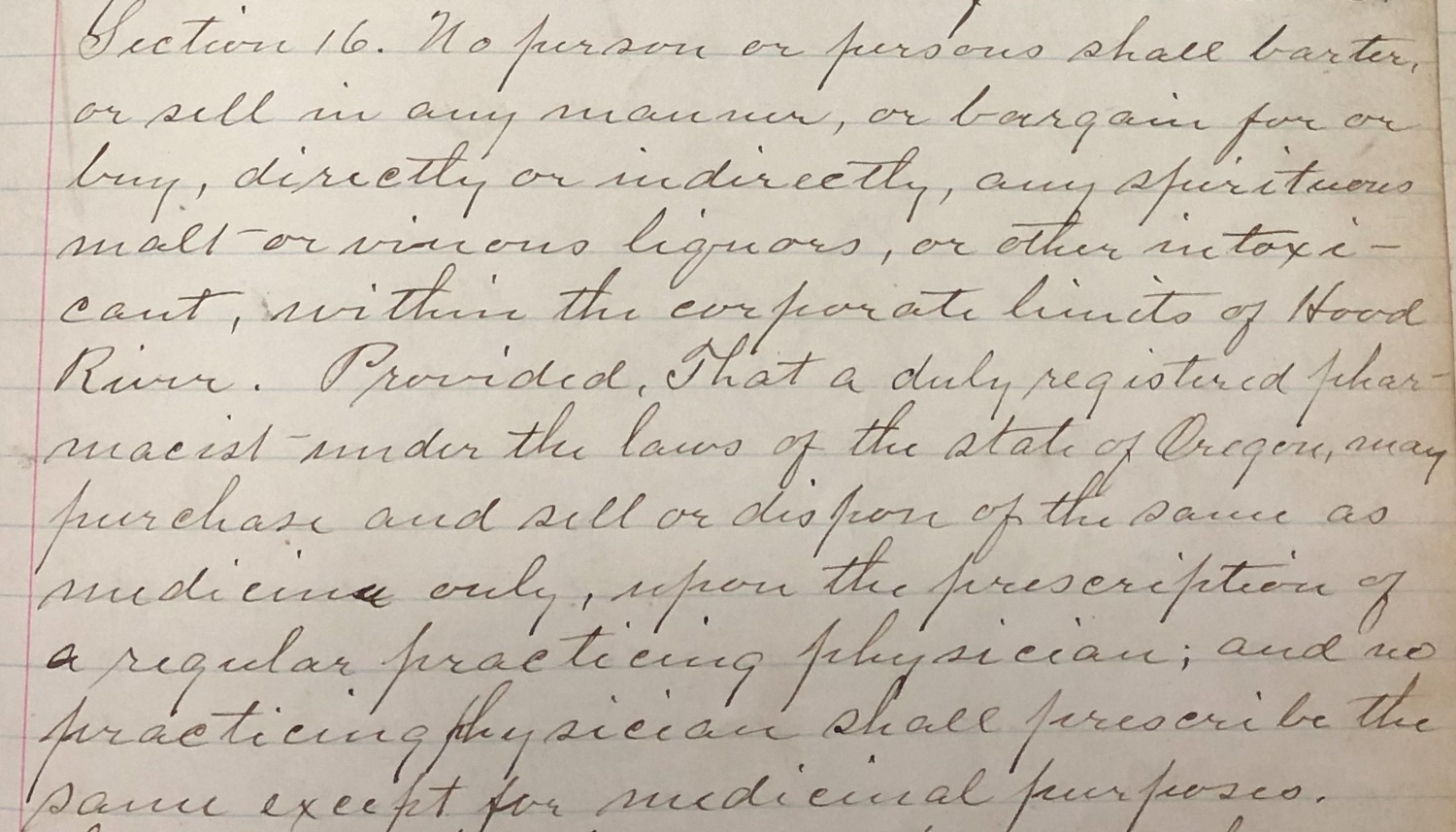
The local temperance movement was a major force encouraging incorporation, so it probably wasn’t surprising one of the city council’s first actions was to officially made Hood River a dry town. Section 16 of Ordinance 5 ordered
No person or persons shall barter or sell in any manner, or bargain for or buy directly or indirectly, any spirituous malt or [various?] liquors, or other intoxicants, within the corporate limits of Hood River. Provided that a duly registered pharmacist under the laws of the state of Oregon, may purchase and sell or dispose of the same as medicine only, upon the prescription of a regular practicing physician, and no practicing physician shall prescribe the same except for medicinal purposes.
Section 17 addressed opium and “houses of ill-repute” so Hood River City quickly established a conservative moral’s code (though I don’t see any prohibition against consumption in private dwellings). This was several decades before nationwide prohibition. I’m not sure if this city prohibition lasted all the way to the end of nationwide prohibition, but over the coming years the newspapers would report frequently of people being arrested for breaking this law. By 1923 The Hood River Glacier included a regular section of “WCTU Notes” (WCTU was Women’s Christian Temperance Union) reporting on such efforts. Here’s a 1910 account from The Hood River News describing regional efforts. Here’s a 1922 story about liquor being poured down the drains right on Oak Street. There must have been a thriving black market.
A couple of anecdotes: Alva Day’s grandson told me his grandfather kept a jug of moonshine under the stairs to the basement of his June Street home. And here’s a charming 1922 story of local court proceedings over possession of liquor by members of the Loop Highway road crew.

Roger Sheldrake
Our grandmother Della Sheirbon was a staunch member of the WCTU until her passing in the late 60’s. She would have had some rather disparaging commentary about at least two of her grandsons. Right Arlen?
Jeffrey Bryant
I think that Tip Top Tavern at the corner of 12th and Belmont was located just outside the city limits because of this or a similar ordinance.
Arlen L sheldrake
Agreed Roger. She had no fear of giving me that $100 for not taking a drink before HS graduation. But in spite of this “flaw” she was quite the lady.
Jeffrey Bryant
The Red Carpet Inn and Y Inn may also have been located to avoid the ordinance. I don’t remember any taverns inside the city limits while I was growing up. However, places like the Elks Club were known to serve alcohol.
JEC
So, Jeffrey, what about Marchbanks?
Jeffrey Bryant
I don’t know about alcohol at Marchbanks. I think of tobacco associated with them. Of course I was too young to really know. I do remember collecting beer bottles at Tip Top Tavern. I think we got 2 cents for them and 3 cents for pop bottles.
Jeffrey Bryant
My step father, Johnnie Van Ras, was bartender at the Elks Club. I asked him to write down some of his stories, but he preferred to let them die with him.
JEC
According to this:https://www.hoodriverhistorymuseum.org/marchbanks-cigars-and-billiards/
Marchbanks had “all your favorite beverages on tap”.
Susan Baldwin
My parents bought the Day’s June Street house in 1956. During a push to excavate and cement the basement’s dirt floor dad found some jugs of hooch – which I remember as dandelion wine. Everyone who knew what kind(s) of alcohol they contained has passed, but those dirt encrusted jugs looked like they’d been buried for a good long time!