
Historic Hood River
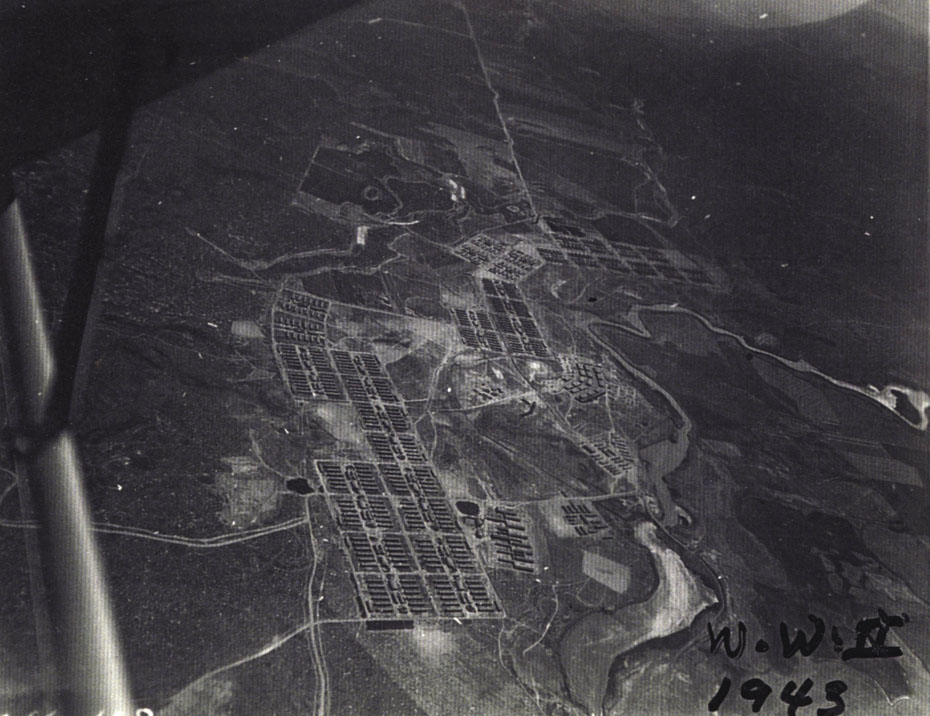
Camp Minidoka, 1943
7-24-2014
Notes

It’s immediately apparent this aerial view is not Hood River. It is Camp Minidoka in Hunt, Idaho. Minidoka is one of the internment camps where Hood River valley residents of Japanese ancestry were placed during World War II. Can you imagine arriving at this walled compound in the middle of this barren wasteland, after living in Hood River?

charlott
What a sad time and a blotch on our own history. I do know some that were interred in this horrible place.
Do we know exactly where this was located?
spinsur
Search google earth for Hunt Idaho. You’ll see Hunt is but the small road intersection just above the left "W" of the handwritten WWII. What’s left of the Camp is but a tiny fraction of what was there as shown in this photo. Interestingly, this same photo is attached in the google earth view with the following caption:
This was also in my dad’s photo "shoe box". Thanks to my cousin Neil, we have identified this photo as an aerial view of the "Minidoka" Internment Camp, located in Hunt, ID, circa 1944. Dad and my Uncle Yutaka and Aunt Haru – along with my cousins – were o
There is another picture of one of the buildings. It may have house a hundred or so(?) folks. Then multiply that by the number of buildings shown here.
Most sobering…
spinsur
Should have mentioned, rotate your google earth view, this photo is looking east.
l.e.
I know an Indian lady whose mother was from the Wasco tribe and her father was Japanese. She can remember her family living in an internment camp and she can remember her little brother being born there.
I often think about what it must have been like to confine her mother to this type of life.
I tell myself that I wasn’t living during these times, so what seems so wrong now, maybe seemed more reasonable. Our west coast had been attacked in a series of feeble attempts.
I also wonder how I would have felt or what I would have done if I would have had Japanese neighbors who were U.S. citizens and watched them be loaded onto trains as Alva Day’s photos depict.
It’s easy to look back and make judgements.
Arlen Sheldrake
wish I had talked to my father more about these times. I do know that he regretted to his end of life what he was told to do as a HR County Deputy Sheriff during this time. He always maintained that those loyal to the Emperor left HR some six months before Pearl Harbor. I remember his telling me the process that he did when a Japanese boy would run afoul of the law…..he didn’t arrest the kid, he went to the family head…the problem was solved. He had a lifetime respect for the Japanese families in HR both in how they lived and how they were able to farm.
But a real fear gripped the west coast…..guards were out protecting the railroad tunnels in HR county……
Yes, a very difficult time made more clear by the multiple excellent books written about the time that I really had no clue about (1941-1960) growing up in HR.
We sure need to continue the struggle to maintain citizen rights even today…..
Kenn
I have great respect for the citizens of Japanese descent, but I cannot describe the fear we had after Pearl Harbor. There was the threat of a west coast invasion, concern for the survival of the nation and unknown loyalty of Japanese/Americans. There was no time for background checks, mistakes were made under stress and fear of the unknown.
Kevin
Sorry Kenn, I don’t buy it. There was a far greater threat from Germany and relatively minuscule number of German-Americans were detained. The response of the US (both government and citizenry) was predominately racist in origin. Don’t think it can’t happen again? – look back at how Arab-Americans were treated after 9/11. Our Constitution must come before the fearful response of the majority.
Buzz
I wasn’t going to comment on this picture, because I have mixed emotions. But I thought Kenn’s comments were honest and with about the proper nuance.. Obviously, in a perfect world Japanes-Americans were treated unfairly by our government. But we don’t live in a perfect world. This world is not about fair, it is about reality. The Germans did not attack and kill Americans on American soil. The Japanese and Arabs did. Imperfect humans will always have strong emotions. And both good and bad deeds will result from those emotions. And racism does not exist solely in this country. What is the old saw about not judging another man, until you have walked a mile in his shoes.
l.e.
The Wikipedia article about Minidoka Camp, lists Minora Yasui as one of the notable internees.
Charlott
A sad mixed up confusing time in all areas. But do keep in mind….that later in the war some of our Hood River Japanese men showed much courage and valor to help defend their homeland, the United States of America. They probably fought harder than a lot of white men, as they unforunately had to prove their loyalty to the country……..I salute them all…………………
I think this is the place that the Yamaki family was sent……………Not certain though…..
l.e.
I must mention Willie and Yoshi Tahara. Long time residents of Glenwood and White Salmon.
Yoshi and her family were interned at Tule Lake Klamath Falls.
Willie fought for the United States.
Two wonderful people.
Cheryl wayland
So interesting all this history! I work in a photo lab in so. California, i am scanning the yearbook of hunt high school 1944, Brillant and amazing young people, in the yearbook noted as "young pionners" whom in the wrong place at the wrong time, endured and were awesome citizens of our country!