
Historic Hood River
Audacity
Notes

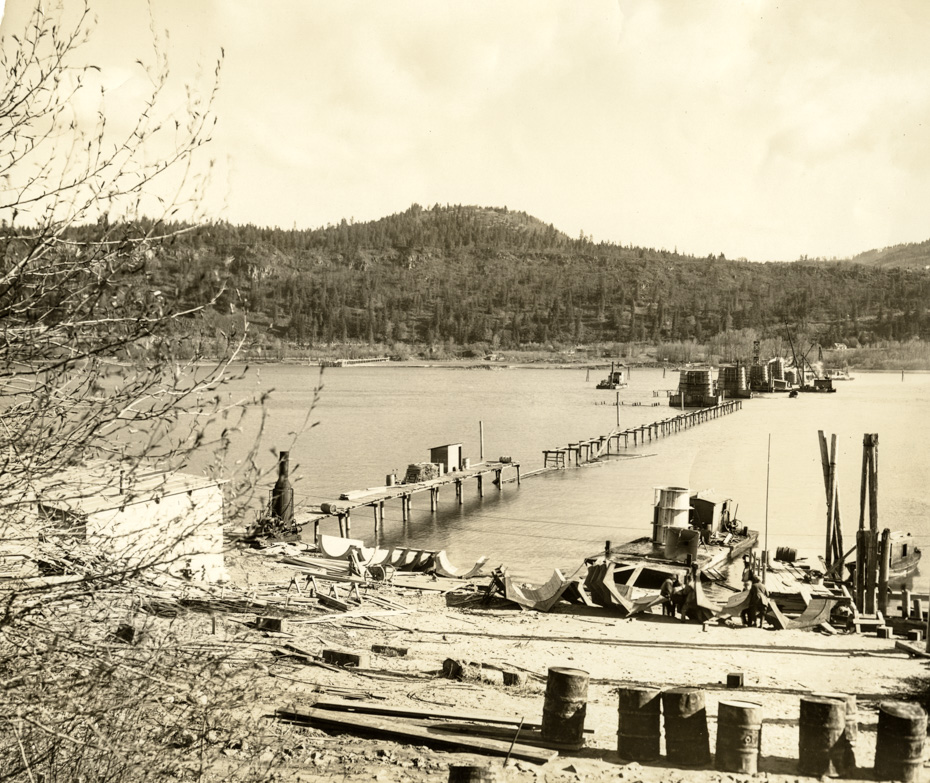
You never know what you’ll find at the Museum. Just when Matt and I thought we’d scanned all the interesting images in the collection, I found an album on a shelf about 30 feet from the scanner documenting the history of the Hood River- White Salmon Bridge.
I think it takes a good measure of audacity to construct a bridge. It’s easy enough to say, “We could use a bridge here.” It’s another thing entirely to launch the enterprise of creating a ribbon of roadway above a river. Think about the technology they had available in 1924– you can see the steam donkey and barrels of concrete.
The bridge opened in December of 1924, and immediately faced a severe cold snap which froze the Columbia solid around those concrete pillars. They survived, and still serve us 90 years later.

Rawhyde
Looks like the men on the beach are working with some circular concrete forms?
Buzz
That is an interesting picture. You could look at it a long time trying to figure out just how they went about the construction. It appears they used some pre-cast concrete pieces on the piers. And it seems to me, for some reason, they started placing piers in the middle of the river. And they seem to be working their way to the other side first. And without some kind of A-frame, what is the purpose of the steam donkey sitting on the bank on this side of the river? Maybe somebody wiser than me can enlighten us. I am always impressed by the ability of many old-timers to not only have the audacity to take on a project, but to be able to solve practical problems as they arise. From some projects I worked on in Alaska in my youth, I know a lot of knowledge is gained by staying alive while learning. and to just keep putting one foot in front of the other, and solve problems as they arise, until you are done.
l.e.
I for one, never complain about the bridge toll I pay to cross the river. For now, the alternatives aren’t more appealing.
But, I am surprised that, even in 1924, there wasn’t more consideration for foot traffic
l.e.
Not much for brush, trees and houses on the White Salmon bluff. Nor the stairs.
You can faintly catch a glimpse of the Cook’s Grade up to Pucker Huddle. Too bad the rock Indian Chief isn’t more visible.
Arthur
The original bridge had far fewer concrete piers, as the approaches were wood. I think those may be the concrete piers which were closest to Oregon in the original construction. As for the circular forms, the only concrete that shape is on the two central piers, supporting the central span.
Longshot
The incomplete pier running out into the river is interesting. What is its purpose, why hasn’t it been finished at this point? Why the gap?
What technique did they use to set the forms and pour the concrete below the water level? Coffer dams, caissons, box caissons?
Longshot
It certainly appears that all of the original piers had circular ends.
https://www.hoodriverhistorymuseum.org?showimage=920
Arthur
Longshot, I can only answer one of your questions. The temporary pier out into the river was in much better shape in an earlier photo without the concrete piers. I think in this image it is no longer in use and is falling apart.
I suspect there is some engineering journal somewhere explaining which technique they used for the underwater concrete work.
David
Are there more construction photos in the collection?
Arthur
There are a few more photos from the original construction in the 1920’s, about a dozen from the reconstruction in the 1930s, and then a few more from re-decking and other modifications in the 1950s.
cg
The river looks so narrow. What was the difference in the width of the river before and after the construction of Bonneville Dam and did the reconstruction of the bridge in the 1930s have to do with the dam?
Pat A
I see the cottonwood trees in this early picture.
And lots of discussions by our blog participants, but the original name Waucoma was not mentioned at all.