
Historic Hood River
Stoops Make Good Neighbors
5-20-2026
Notes
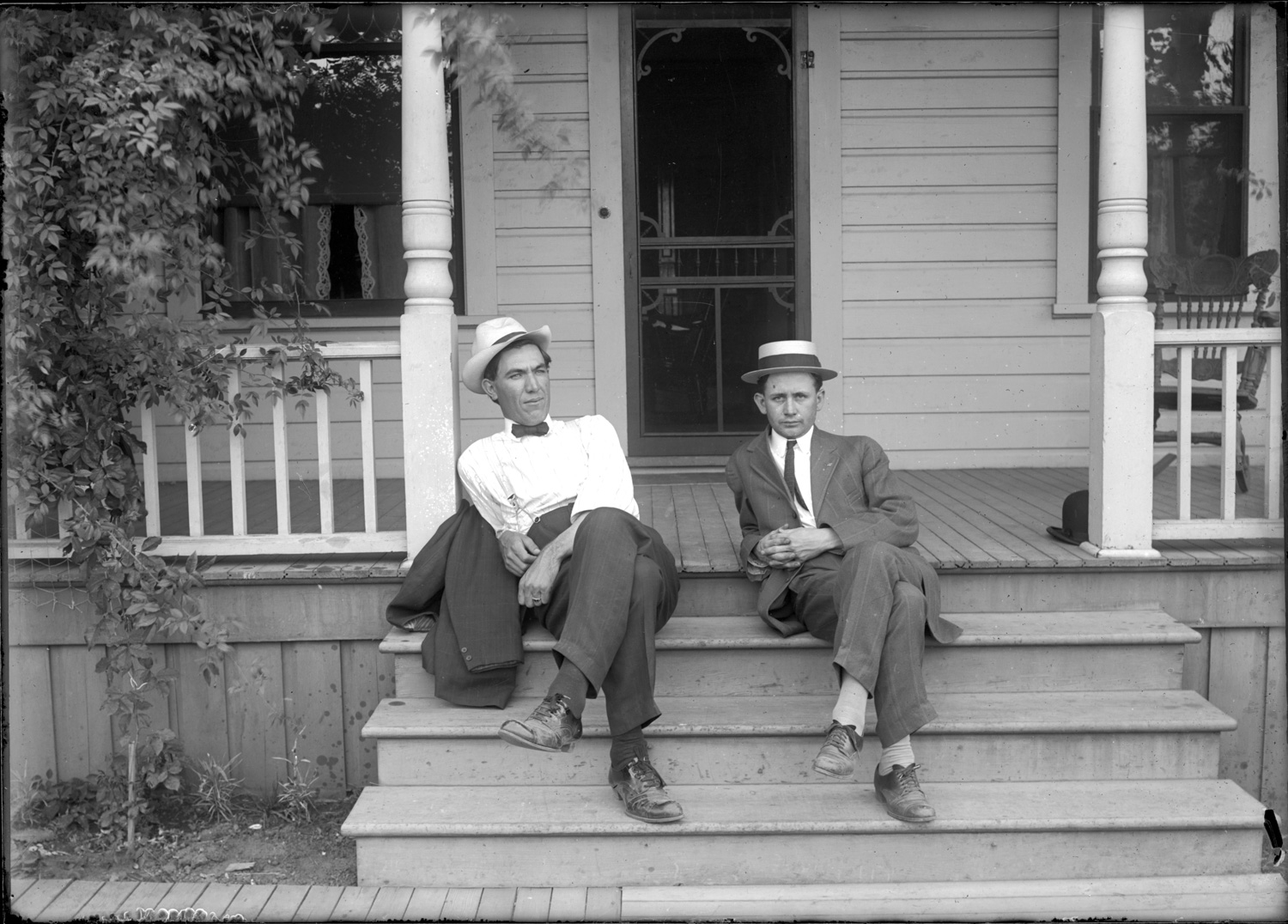
This is a good image to promote the idea of front porches. Our car culture often faces garages onto the street instead of a porch where you might interact with neighbors passing by. This is of course the Laraway house at 214 Front Street. The date is circa 1910, before sidewalks were paved. I’m not sure who the men are, but it looks like W. F. Laraway left his hat on the porch while he went to snap the photograph.
We know Laraway bought his Marmon automobile about this time, and built a driveway next to the house with a garage in the back. Family members report he had a turntable so he could exit facing forward instead of backing down the driveway. I haven’t been able to find a photograph showing this, but I keep searching.

Dale Nicol
Speaking about turn tables for cars…..Henry Ford had one installed inside the family’s Dearborn garage, soon after Clara Ford crunched a rear fender on her 1908 Detroit Electric while backing it out. DE’s are difficult to see out of due to the cab design. Another issue is when engaging either forward or reverse, the car does not have a “soft start” and “jumps” soon as the battery is connected to the motor’s mechanical speed control. Steering via a “tiller” is not possible until the car starts to move. You can go for a 1914 Detroit Electric ,on Second Saturday’s at WAAAM. Clara Ford’s last DE was a 1914 model just like WAAAM’s.
No doubt WF Laraway’s turntable eliminated issues backing out his car, especially if there was a uphill grade.
Arthur Babitz
I suspect the Marmon handled like a boat.
L.E.
Great photo. Front porches were a, “welcome to my home”, feeling. Or they were great for sitting in the rocking chair and watching the world pass by. Or you could pile them with junk, out of the weather.
Now days, inspection would not pass. No hand rails.
Arlen Sheldrake
I appreciate railings!!!arlenn