
Historic Hood River
Out For a Drive
Notes
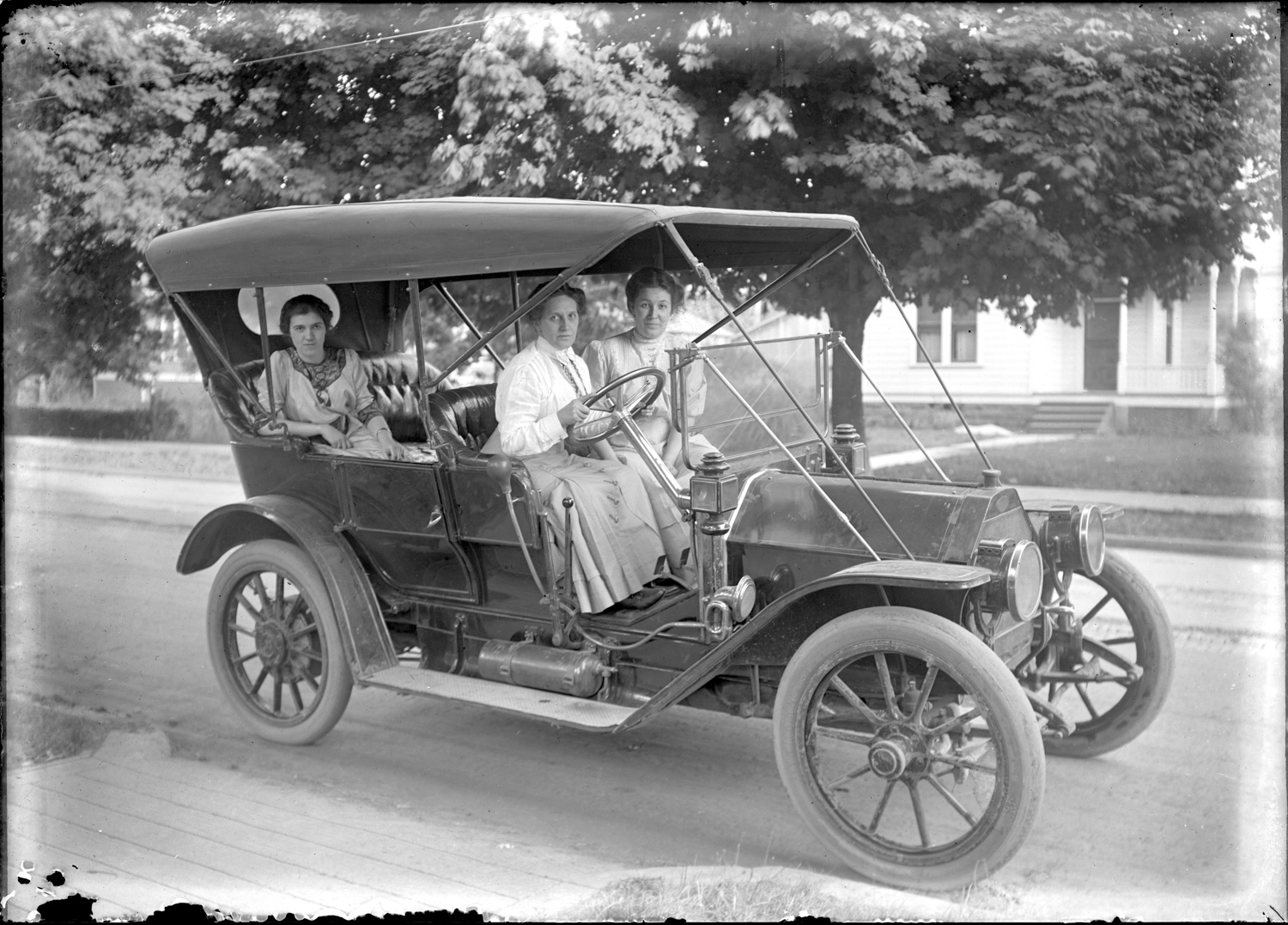
These ladies are posing in W. F. Laraway’s pride and joy, his 1910 Marmon Model 32. This is a good view to see some of the mechanical systems in the car. It has a beefy front suspension compared to the much lighter Model T. The tank on the running board is the “Presto tank” which was filled with compressed acetylene gas to power the lamps.
We have service invoices indicating is cost $1.75 to “recharge” the Presto tank, which is about $55 today. If you’re wondering why they didn’t use electric bulbs on early automobiles, there are two reasons: First, most early gas powered autos used a magneto to generate the spark, but often didn’t have a battery to store energy to power a bulb when the engine wasn’t running. Only when electric starters became popular did more sophisticated electrical systems come to automobiles. The second reason is it’s actually hard to make electric bulb filaments that can survive in the automotive environment. Vibration and thermal shock (changing temperature) break delicate filaments, as did the unregulated voltages produced by magnetos. By the 1920s automobile owners were able to avoid expensive carbide generators or acetylene tanks, though they would still need to replace the electric light bulbs frequently. Halogen bulbs and then LED lamps have made constant bulb changes a thing of the past.
A few other details to notice: Check out the beautiful bulb horn– it looks like a musical instrument. If that’s the “Stewart Hand Horn” on a service invoice, it cost $5 ($163) plus $0.25 for installation. Those large rear brake drums were needed to stop this heavy car. And then there is the folding windshield. I’ve never been clear if that’s to provide ariflow, which doesn’t seem like a problem in an open car like this, or to get better visibility if your windshield is covered with dust. Maybe Dale will fill us in.
I’m not sure which street they are on. There are only a couple of streets this flat in town, and it’s unlikely they got very far from Hood River with the state of roads in the early 1910s.

Will
If that is, in fact, a driveway in the fore left ground, when did they start to appear?
Roger H Sheldrake
The rear window probably not glass? Isinglass I think in the word for an early vinyl product. Did this car have roll down side curtains?
Arthur Babitz
Will, driveway at the Shaw house on 9th predates this: https://www.hoodriverhistorymuseum.org/in-a-desperate-hurry/
L. E.
Beautifully clear photo. Did you have to pump the brakes in these cars?
Roger H Sheldrake
No pumping of brakes here!! No hydraulic fluid!! All mechanical much like the arm strong steering.
Dale Nicol
Arthur, not sure why the split windscreen, but I would guess maybe the glass companies had not developed methods to produce larger single panes of glass??
The photo is really full of excellent details due to the quality of the camera/equipment and the Marmon is a beautiful car.
One thing to mention about the carbide generators and acetylene storage tanks is they became less commonplace after GE developed the Mazda bulb around 1910. This new bulb had a very robust filament and support that stood up to vibration and the voltage swing of Model-T’s flywheel magneto generator. Around 1915 Ford offered electric lights, powered by the flywheel. Using a Mazda bulb, the light intensity would increase and dim based on the engine RPM. Ford did not offer a starter and generator until 1919 as an option and then made it mostly standard equipment in 1920.
This was a very popular improvement as hand cranking the engine allowed more people to easily start the engine and greatly reduce broken arms, hands and wrists.
Ford was about 3 years behind Chevy’s that were equipped with starters and generators. They also had a floor mount 3 speed transmission unlike the Model-T’s planetary gear transmission.
Arthur Babitz
Interesting question about pumping brakes– there is more to it than hydraulic fluid. On Model Ts you pump the brakes because you need lubrication between the brake band in the transmission and the brake drum– very counter intuitive, but you have to release the pedal so oil can splash up. Also, I think mechanical brake drums can have “brake fade” when the friction compound gets too hot, so I think you would have wanted to pump the brakes on this Marmon. Dale?
Dale Nicol
I know people quickly learned about drum brake fade in hilly terrain, so pumping the brakes was a lesson well learned. The other important consideration was “gearing down or down shifting” before you got going too fast. Think about the reasons why we still have today, runaway truck exits 😉