
Historic Hood River
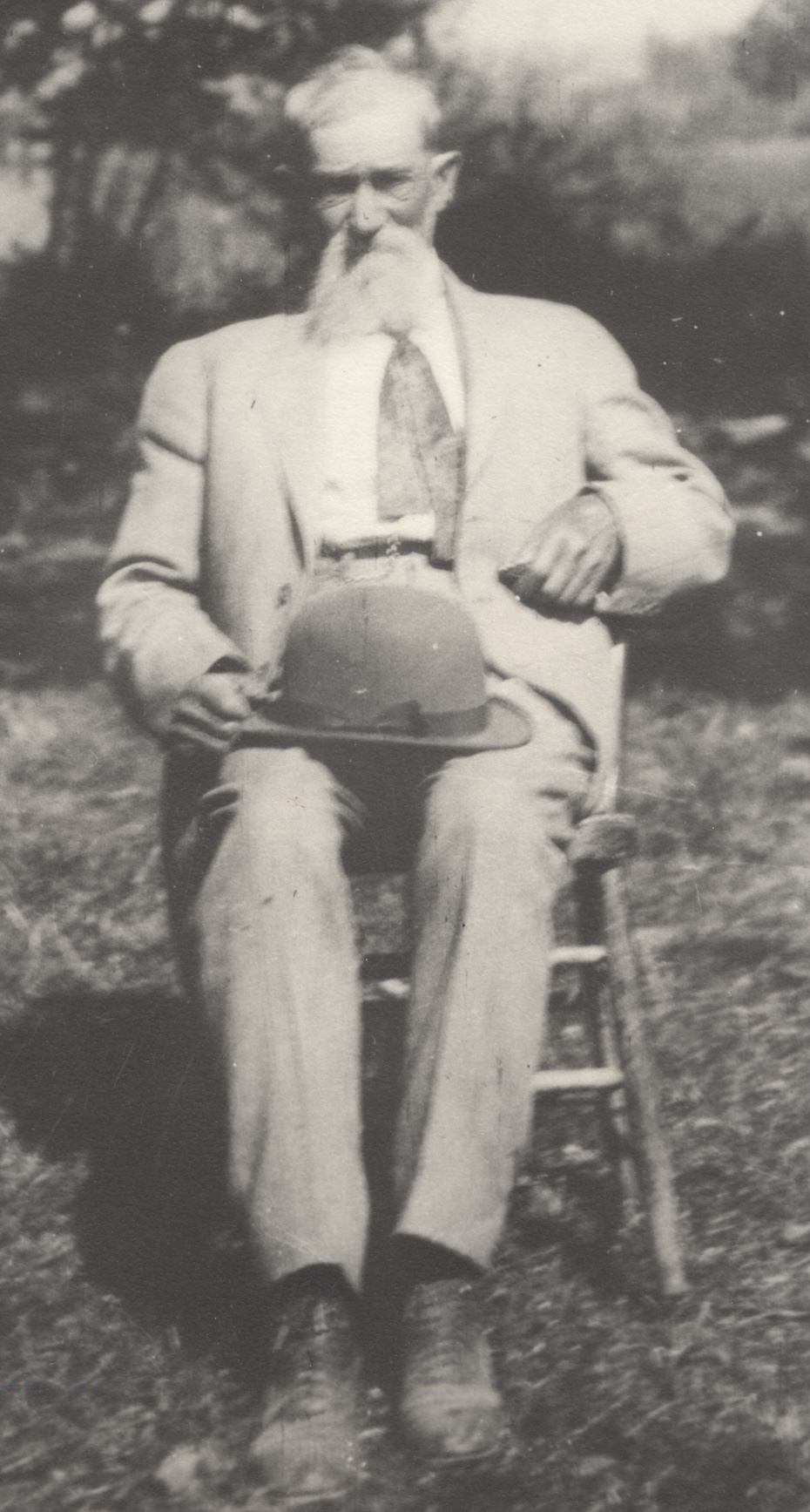
Captain Francis Marion Jackson
Notes
This image of Captain Francis Marion Jackson got to the museum through a circuitous route. Notes on the reverse indicate it was “Presented to Arline Moore by Nettie Elder, Formally [sic] Mrs. F. R. Jackson.” A further note, dated January 30, 1961, is addressed to Bernice Jackson by Arline Moore. It says, “Because I feel some one near of Kin should have this very good picture of Captain Jackson. When I am gone my children will not know anything about him. His name will mean nothing.”
Let’s do something about that. Here’s a biography of Captain Jackson, who died in 1914 and is buried in a family cemetery in Pine Grove.
Given Arline Moore’s reputation for her work in social justice, I was surprised to learn Captain Jackson was a slaveholder who fought for the Confederacy. He made his way to Pine Grove about 1871, and lived there the rest of his life. As a Pine Grove resident he would have been a neighbor of Arline Moore from her earliest childhood.
The mixing of former battlefield enemies in Oregon must have made for some interesting politics. I can only wonder how Samuel Blythe and his comrades in the Canby Post of the GAR felt about former Confederates in the valley. I found a quote from Captain Jackson saying he subscribed to The Glacier from its very first issues, but nothing to indicate the nature of the relationship between Jackson and Blythe.
The pages of The Hood River Glacier indicate Captain Jackson was active in the “Good Roads Movement” as early as 1904, strenuously advocating for local road taxes. He also served on the school committee and advocated for school tax measures.

BethH
The Jackson cemetery sits off of Fir Mt Rd – it’s off to the west of the first 90 degree corner heading up Fir Mt.
Doug Dethman is the care taker. He and his wife live on Bernice’s property, further up the road.
Captain Jackson is his maternal great grandfather…or great, Great?
I’ve sent this to him and his sister, hoping they can fill in other information.
But Your highlighted info on the Capt says it all.
His daughter married a Gerdes and ran the Gerdes hotel in downtown.
Jeffrey Bryant
Oregonian, January 13, 1914
Capt. F. W. Jackson Dead
Confederate Veteran Who Fled With Jefferson Davis, Passes
Hood River, Or., Jan. 12 – (Special) – Captain F. M. Jackson, who was one of a handful of soldiers with Jefferson Davis when the Confederate President was captured in his flight southward after the fall of Richmond, died here today, aged 77.
Captain Jackson was a native of Tennessee. Shortly after the war he came West, and resided for 42 years in the Hood River Valley.
Although he fought under the Stars and Bars in the Civil War, Captain Jackson numbered among his best friends the members of the Grand Army Post here.
“We fought against each other,” said E. D. Calkins, an old veteran who lost a leg at Antietam, “but I have never had a better friend.”
Members of the Canby Post will act as pallbearers at the funeral.
Captain Jackson left five children: Mrs. John Gerdes, J. B. Jackson, D. M. Jackson, all of Hood River; W. F. Jackson, of Moro, and F. R. Jackson, of Sumpterville, Wash.
—
An Illustrated History of Central Oregon, Western Historical Publishing Company, Spokane, WA. 1905, pages 324-325
FRANCIS M. JACKSON, a well known and highly respected horticulturist and farmer of the Hood River valley, resides about seven miles south from the town of Hood River, and was born in Athens, Tennessee, on December 13, 1836. His parents, John B. and Dorcas (Cox) Jackson, were pioneers in Tennessee. The father was born in North Carolina, as were also his parents, and when sixteen he went alone to Kentucky, where he married and whence he returned later to Tennessee. He was a man of refinement and education, being especially skilled in mathematics and music. He was professor in Monticello academy, Kentucky, and later taught music. He finally published a musical work that netted him a nice profit. He was clerk of McMinn county, Tennessee, for many years and died in Morristown, that state, in 1858. His wife died in the same town in 1858. She was descended from an old southern family. Our subject lived in Morristown from the age of six to seventeen and received an academic education there. Then he traveled with ox teams to Missouri, and in the spring of 1856 continued his journey on to California, where he wrought for two years and six months at mining. Owing to his father’s death he then returned to the east and remained on the old place for some time and bought a farm and some slaves. Owing to rumors of war, Mr. Jackson did not return to California as he originally in-tended to do, and in June, 1861, enlisted in the Fourth Battalion of Tennessee Cavalry, his command being known as Peck’s Light Dragoons. He had served only two months as private when he was promoted to a lieutenancy. Previous to enlistment, he had assisted to organize another company, but as there was not a probability of their being allowed to go to the front, they were disbanded. His regiment was mostly in Kentucky and upper Tennessee, and he served as first lieutenant until the Wild Cat fight, General Nelson federal commander and General Zollicoffer confederate. The captain of Lieutenant Jackson’s company resigned and he was unanimously elected to the position by acclamation. He was in Fisher Creek battle, near his father’s old home, in which conflict General Zollicoffer lost his life; our subject’s regiment was defeated and fell back into Tennessee. Captain Jackson was in two fights near Vicksburg, but did not participate in the siege. He was captured in the Black River battle and suffered eighteen months at the war prison in Johnson’s island near Sandusky, Ohio. Being exchanged, he visited at his old home and then returned to his regiment and was acting colonel until the close of the war. His commission was on its way for a colonelcy when the war closed. Captain Jackson fought hard and long for the cause he thought to be right and after the war returned to his old home only to find the war feeling so strong that his life was in danger. His finances were ruined by the war and what little he could recover he promptly used to liquidate debts he owed for slaves bought on credit. When his debts were all paid, he had little left and so started life anew. For the last two years in his town, Morristown, he was city recorder and was nominated for mayor when he had decided to some west again. He came to The Dalles via San Francisco and Portland, and soon after arriving took the place where he resides at this time. Since then, the Captain has bestowed his labors here with a good measure of success. He is skilled in horticulture and also does some general farming. Captain Jackson is a man of integrity and honor and his keen sense of justice and uprightness are known to all by virtue of a worthy and commendable life.
On June 8, 1859, at Morristown, Mr. Jackson married Miss Elizabeth L. Thurman, the daughter of William M. and Mary (Bibb) Thurman. The mother of Mary Bibb was Elizabeth Lewis, related to Captain Lewis of Lewis and Clark fame. Mrs. Jackson was a member of the well known Thurman family, one of whom was candidate for vice president with Cleveland. Her mother’s mother was a member of the Sutherland family, prominent in the south, of Scotch extraction, members of which served in the Revolution, among which was Mrs. Jackson’s grandfather. Our subject has two brothers, David C., a captain in the confederate army, for many years postmaster at Summitville, Tennessee, and, now farming; George W., a preacher in Denton county, Texas. Also, he has one sister, Elizabeth S., wife of S. M. Sawyers, a civil engineer of DeSoto, Kansas. Mrs. Jackson had one brother, Preston C., an attorney in Bonham, Texas. She had four sisters: Martha C., who dwells with our subject; Mary J., widow of J.B. Jones, of Fannin county, Texas; Lucy V., single, in Texas; and Josephine, wife of Mr. Wood, in Fannin county, Texas. Captain Jackson has five children living: Carrie L., wife of John H. Gerdes, proprietor of Gerdes house in Hood River; William F., a farmer near Moro, this state; John B., living with his father and owner of the adjoining farm; David M., with his father; and Francis R., living on a homestead near his father’s home.
It is of interest in this connection to state that our subject was a member of the escort of Jefferson Davis up to the time of the capture. Mr. Davis left the escort the day before the capture to visit his family. Our subject is a Democrat in politics and for twenty-nine years he has been director of the district school where he lives.
He was the prime mover in the organization of the Pine Grove district and has shown commendable interest in the building up of the country. He has twice been nominated for county commissioner and, although running far ahead of his ticket, still suffered defeat.
—
History of Early Pioneer Families of Hood River, Oregon. Compiled by Mrs. D.M. Coon
F.M. JACKSON AND FAMILY D.M.C. 1873
Francis M. Jackson, with his family, came to Hood River in 1871. He took up a homestead on the East side on which he lived nearly forty three years.
He was born in Athens, Tennessee on December 13, 1836, his parents, Mr. and. Mrs. J.B. Jackson, being pioneers of that state. They moved to Morristown, of the same state, while he was still small.
He grew to manhood and received an academic education in his home town. In 1853 he drove an ox team to Missouri and in the spring of 1856 journeyed to California and engaged in mining. The death of his father called him home in the fall of 1858.
On June 8, 1859, he was married to Miss Elizabeth Thurman, and bought a farm and a number of slaves on credit soon after the Civil War began. In June 1861 he enlisted in the 4th Battalion of Tennessee Cavalry, known as Peck’s Light Dragoons.
He was soon promoted to the office of lieutenant and then to that of captain. He was in the Fisher Creek battle and the battles near Vicksburg. At the battle, of Black River he was taken prisoner and held on Johnson’s Island, near Sandusky, Ohio, for eighteen months when he was exchanged. After a short stay at his old home he rejoined his former regiment and was serving as colonel when the war closed. When Jefferson Davis, President of the Confederacy, was captured, Captain Jackson was one of his escorts, but temporarily absent. At the close of the war he returned to his farm and endeavored to pay off his debts contracted in the purchase of slaves before the war. He served as city recorder for two years, then, with his obligations discharged he turned to the West.
He came to The Dalles and learned of Hood River, he visited it in its primitive wildness and was fascinated, and this became his permanent home. His wife was a relative of Captain Lewis, of “Lewis and Clark” fame. Together Mr. and Mrs. Jackson labored in Hood River, he had no work in which she did not share, suffered no privations in which she was not an equal partner.
They improved their farm, raised a family of five children, contributed to the general welfare of the community and won the respect of their neighbors. He served for thirty years as school director in the Pine Grove District. He always took an active part in public affairs. Mrs. Jackson died in 1885. Mr. Jackson’s health began to fail in the fall of 1913, he died at his home on January 12, 1914. The children surviving are Mrs. Carrie Gerdes, J.B. and D.M. Jackson of Hood River, W.F. Jackson of Moro and Francis J. Jackson, a Baptist minister of Centerville, Washington.
In compliance with the request of Captain Jackson he was buried in his Confederate uniform.
“Under the sod and the dew,
Waiting the Judgment day,
Love and tears for the Blue,
Tears and love for the Gray.”
From an article concerning Captain Jackson published in a Portland paper I quote: “Although he fought under the Stars and Bars in the Civil War, Captain Jackson numbered among his best friends the members of the Grand Army Post here.”
“We fought against each other”, said E.D. Calkins, an old veteran who lost his leg at Antietam, “but I have never had a better friend”. Members of the Canby Post acted as pallbearers.
—
The Hood River News, Hood River, OR., July 2, 1943, page 1
CAPTAIN FRANCIS MARION JACKSON CAME TO HOOD RIVER VALLEY IN WINTER OF ’71
(By Arline Winchell Moore)
One of the most picturesque figures in the gallery of my memory is that of Captain Frank Jackson of the Confederate army, riding past our home in the Pine Grove district at a regular cavalry pace. He always owned a better than average horse, always rode at a military clip and sat in his saddle with a military erectness, learned during his years of service in the Southern army. In spite of the military preciseness, there was also evident the natural grace and ease of the born horseman. We children very early came to recognize the rhythm of his horses hoof beat and always tried to reach a vantage point to view his passing. So nearly a part of him was his horsemanship, that he was able to ride at his usual clip up to within a very short time of his death. At the advanced age of seventy-six, the sly inroads of arterial trouble, with its accompanying spells of sickening dizziness, brought about a nasty spill from which the captain never recovered.
According to J.B. (John) Jackson, who lives of on the Fir Road on the property adjoining the original Jackson claim, in fact part of his own holdings are from the old home place, his father Frances Marion Jackson was born in Morris, Tennessee, in 1836. The Jackson family owned a large plantation, well attended by many slaves. This was one of those Southern families who believed the precepts of our constitution, in that “all men are born free and equal,” and in accordance with that belief made freedmen of all their slaves long before the bitter difficulties that finally led to our great Civil strife. However, the kind treatment meted out to these people bore fruit in a refusal to leave the place on which most of them had been born. Even though operated by freedmen, the plantations still prospered and carried on with little or no change from the old way of life.
In 1859, young Frank and his brother David crossed the plains by ox team to California, drawn there like others of that age by the lure of the gold fields. And like many others they did not find the gold they sought and moved on north into the Oregon country. There word reached them that their father had been called to the better world and the brothers returned to Tennessee. They had been hardly been able to adjust themselves to the management of the big estate, when the bitter strife of our Civil War was upon them.
Captain Jackson went into the war as captain of his own company, and was at one time detailed as the body guard of President Davis. Typical of the loyalty of the negro slave, is the story of a boy — once owned by the Jackson family, but a freedman since his early youth – whom the family called Uncle Billy. A few years older than F.R., he had been given the care of his young master almost at birth and accepted this responsibility with all the loyalty of his nature. When the captain went to war the negro boy went along to “take care of his master.” I remember hearing the captain tell of how he had forbidden the lad to accompany him, but when he was well on his way and the time came for the first night’s camp to be made there was Billy happily making his “Marse’ bed.” The captain tried to make the boy understand that a servant could not accompany his master to war, but Billy went along anyway.
At the battle of Chattanooga, the captain’s company was practically demolished and his own horse was shot from under him. Captain Frank was so injured that the negro boy carried his master to his home on his own back, where several months passed before the captain could return to the field of action. As soon as he was able, he recruited and trained another company of men. Uncle Billy stayed by his “Master” until circumstances sent the captain back to the Great West without him, but the darky never forgot his beloved “Master.” Years afterward the captain went east to the World’s Fair and paid a visit to his old hometown. Some way Old Uncle Billy had learned that the captain was coming home, and his was the first welcoming face the captain saw as his train pulled into the home depot.
At the close of the war the captain returned to what was left of the old plantation and with the help of a few loyally negroes, his wife and his wife’s sister, Mrs. Delia Thurman, Captain Jackson carried on to the best of his ability. In the ensuing years, two boys, and one daughter, William Jackson of The Dalles, Oregon, J.B. Jackson, of Hood River, and the late Lillian Jackson Gerdes, of Hood River came along. Presently the health of his wife became so delicate that the doctors ordered a change of climate. By 1870-71, the infamous carpet-beggars that came so near destroying the South, had introduced so much of their nefarious work that the once splendid plantation brought little more than enough to bring the Jackson family out to Oregon. Some of the loyal negroes followed the family to the train, weeping and begging to be brought along. I have heard the Captain tell my folks that the hardest thing he ever had to do in all his life was to refuse the supplications of those loving people. At the last moment, if he had had sufficient funds, he would have relented and brought them with him.
Captain Jackson brought his family to San Francisco by train. There they boarded a dilapidated sailing vessel for Marshfield, Oregon. The fall season, which brings bad storms to the ocean, was at hand and J.B. says that the boat was scarcely out of San Francisco Bay before a bad storm struck and by the time of the Oregon coast was sighted, the weather was so bad that the captain of the boat had warned all on board to put on life preservers. Also told them that he doubted whether he could bring the boat through. He would not even attempt a landing at Marshfield, where landing conditions in good weather were rather precarious. He brought his cargo safely through to Portland. J.B. says the family often spoke of how seasick the entire bunch was except himself. Placed on the floor to amuse himself, he derived great pleasure from being rolled from side to side of the cabin by the heave of the laboring vessel.
Somewhere Captain Jackson had made the acquaintance of someone who advised proceeding to Fort Dalles, then still experiencing the prosperity brought by the Eastern Oregon gold rush. On reaching The Dalles, about November 15, 1871, Captain Jackson found that the decline of the gold field prosperity was well on its way. The settlement of Hood River Valley was then the urgent talk.
My grandfather, Jerome Winchell, had just passed on, early that fall and Grandmother Winchell and her children were living with her own people, the Peter Neal family. As was often the case those days, Captain Jackson called at the Peter Neal home the first thing. As Grandpa Neal had once lived in Tennessee, the Captain and Peter Neal were soon fast friends, and arrangements were made for the Jackson family to move right into my Grandfather Winchell’s house, on the place, today, known as the Fike ranch. The family was settled in their quarters about December 15, 1871, with less than fifty dollars cash in hand and three feet of snow on the ground. All that winter snow covered the ground, each fall crusted over, and the next fall piled up on top with little or no thawing. The southern family had never experienced anything like it. Imagine a family accustomed to the ministrations of negro help, in a new country, with three small children and the mother in frail health. Indeed, our pioneers were a tenacious people.
In the spring the family moved to the property, now owned in part by the sons of Captain Jackson. Peter Neal gave Captain Jackson work cutting logs for the mill at $1.00 per thousand feet. J.B. says that often he has heard his father talk of stepping those huge yellow pine trees and cutting above the snow, and then they would have to dig the snow away to trim and cut the logs. No saws were available – all the work was done with an ax.
In spite of the hardships, the family muddled through and became one of the backbones of this new country. Miss Delia Thurman turned her own educational advantages to the aid of the youth in this new land. She taught a number of terms in the early schools. After a time three more children came along, Mabray, who is a real estate agent in Portland; Frances Roy, a retired minister, who lives on a part of the old place, and the youngest, Mattie, who died very early and was the first to be placed in the little family plot under the trees near the old Jackson homestead cabin.
J.B. says that when Mattie first became ill, it was at the school near the Lenz Station, and that M.D. Odell carried her to their home the two and one-half miles, in his arms. Little Mattie never recovered from this illness. Several others of this family have since been placed beside the little girl. There is the aunt, Miss Thurman, the mother, Elizabeth Jackson, the captain, the wife of Frances Roy and their two sons and two daughters.
Captain F.M. served as director of the Pine Grove schools perennially for years and years, and though he buried his own loved one in a sanctuary of his very own, he worked for the improvement of the grounds my people gave to the public in 1889. On more than one occasion, when a new fence was needed or a survey of the lots, the captain with his friend and neighbor, D.A. Turner, solicited the necessary funds and gave liberally from his own toward the project. He gracefully accepted the defeat of the southern cause and was for years a fast friend to members of the Canby Corps, G.A.R., often working side by side with this group in support of their many civic activities.
In 1912, a short time after a bad fall from his horse, the captain was laid beside the wife of his youth near the home in which he had lived at peace, enjoying his books for more than forty years. Books and subscriptions to magazines and papers was about the only material thing salvaged from the early, easier life in the old south. My mother loved to read, and another pleasant memory of my childhood is the pleasure my mother derived from the many books and papers the captain was always bringing to our family when he had finished with them. People such as these built for us this great, good country.
—
The Hood River Glacier, January 15, 1914, page 2
Capt. F. M. Jackson Called By Death
The funeral services of Capt. Francis M. Jackson, who died Monday morning at his East Side home seven miles from this city, at the age of 77 years, was conducted yesterday morning at the home, after which interment followed at the burying ground on the old homestead. Capt. Jackson, who with the exception of D. A. Turner, of this city, was the oldest surviving Hood River pioneer, was a soldier in the Confederate Army, having enlisted in 1861 in the Fourth Battalion, Tennessee cavalry. He was a member of the escort of Jefferson Davis, president of the Confederacy, until the latter’s capture. The president left the escort the day before the capture to visit his family.
The deceased had steady promotion during the war, during the most of which he served under General Zollincoffer in East Tennessee and Kentucky. He was captured at the battle of Black River and was a prisoner for 10 months.
Capt. Jackson was one of the most beloved men of the Hood River valley, where he has resided for the past 42 years, having come here from The Dalles, to which place he came from the state of his nativity, Tennessee, via San Francisco and Portland after the Civil war. He was respected and honored by the local Post of the Grand Army, the members of which were his closest friends, and the old veterans, wearers of the Blue, were escorts to the body of Capt. Jackson. Mr. Turner, who came to the Hood River valley 52 years ago, and whose homestead adjoined that of Capt. Jackson, says: “I never had a better neighbor.”
The old home place of Capt. Jackson at Athens, Tenn., was fairly pillaged during the war and when the days of battle were over he was ruined in fortune. But he was successful on his new location here and was known as one of the valley’s best orchardists.
While a youth Capt. Jackson had left his home and had dug gold with the “Forty-Niners” lured to California. He had returned to Tennessee on account of the fatal illness of his father. He was wedded in 1856 to Miss Elizabeth Thurman. The wife has been dead a number of years. Five children survive him: Mrs. John Gerdes, J. B. Jackson, D. M. Jackson, all of Hood River; W. F. Jackson, of Moro; F. R. Jackson, of Summerville, Wn. Twelve grandchildren are left surviving.
The funeral services were conducted by Rev. G. E. Heinick and Rev. Troy Shelley.
L. E.
Interesting history. Thanks Arthur and BethH.
Life for southern Civil War Veterans who moved from the south was not easy. We don’t know all the reason’s they fought for the south. Slavery may have been a minor issue for them.
Native Americans in this area were slave holders. That is probably not why they fought in the battles of the PNW.
Arthur Babitz
Thanks Jeffrey for those references which assert Captain Jackson had a good relationship with local GAR vets like Ed Calkins. When you get to know your neighbor as a neighbor their history becomes less relevant.
Jeffrey Bryant
Sorry for a long input.
Rodger Nichols
Nettie Elder, referenced in the original caption, was originally Nettie Fridley of Sherman county. She was the second wife of Rev. F.R. Jackson, Captain Jackson’s son. After his death, she became the second wife of my grandfather, Rhuben C. Elder. Both are buried in the Pine Grove Cemetery.
Gina Foxley
Francis Marion Jackson was my Great Grandfather. The following is a biographical sketch of him written by my Grandfather, Francis Roy Jackson.
Francis Marion Jackson was born in Athens, Tennessee, December 13, 1836. His parents were John B. Jackson and Dorcas (Cox) Jackson, pioneers of Tennessee. Francis M. Jackson lived in Morristown, Tennessee from the age of 6 to 17 years. In 1855 he and a borther, David, travelled to Missouri by ox team. Then, in the spring of 1856 they continued on to California where they remained for two and one-half years while mining. In 1858, following his father’s death, Mr. Jackson returned to Morristown, Tennessee. He was married to Elizabeth L. Thurman_ on June 8, 1859, at Morristovm. In June, 1861 he enlisted in the Southern Army and remained in the army until the capture of Jefferson Davis.
In 1871 he left Tennessee on account of his wife’s health and went by train to San Francisco and by sailing boat to Portland. Enroute to Portland he was in a storm which lasted 72 hours. From Portland they went by boat to The Dalles where they remained for about two months. They moved to Hood River in November, 1871.
About three and one-half feet of snow was on the ground. A family by the name of Ward, living on what is known as the Button place, met the boat and took the family to their home for dinner. Joe Ward, a son, hitched four horses to their bobsled and loaded the family and their belongings in it. He took them to what is known as the Winchell house which stood just across the road from the Fike house.
The family consisted of Captain Jackson, Mrs. Jackson and their three children: Carrie Lillian Jackson, born April 5, 1866; William Forrest Jackson, born April 22, 1868; John Bascom Jackson, born June 26, 1870, and Cordelia Thurman, who was a sister of Mrs. Jackson. After their arrival in Hood River three other children were born: Martha Cordelia, December 9, 1873; David Mabry, March 17, 1876; and Francis Roy, June 27, 1878.
The following spring Captain Jackson homesteaded the NW1/4 of Section 30 Township 2N Range llE. He cleared over an acre of ground, fenced it with rail fence, built a reservoir and irrigated his land. He worked for Neals a great deal of the time, cutting saw logs. In addition to all this he built a small house for himself and moved his family into it the fall of 1872.
There were no public roads on the East side of what is now Hood River County for some time after Captain Jackson came here and it was necessary that there be thirteen signers to the petition before one could be approved. He was one of the thirteen petitioners. Also, at that time all trading was done in The Dalles as there were no business houses in Hood River. He also worked with others to get the first school in the Pine Grove district and served on that school board for thirty years. On December 13, 1884, Captain Jackson’s birthday, a fine dry snow started falling and fell continuously for fourteen days. There were various reports of the snow reaching a depth of from five to nine feet but Captain Jackson measured it after it had settled and it was five feet then. There were no roads opened so the only way to get to town to get the mail was on skis until March. Odell’s had five horses on top of Fir Mountain for which they carried hay on skis and managed to get them down to within about three-quarters of a mile from the old Harry Kemp place where there was plenty of hay but they all died.
Captain Jackson nearly always served on the grand jury in The Dalles and was also election judge in his precinct. In the year 1894 he took the election returns to The Dalles by boat. Arriving in The Dalles, the water was so high it came up to about the ceiling of the first story of the Umatilla House. On Fourth Street he took a boat to get to the Umatilla House and they entered through a window in the second story. M. P. (Pete) Isenberg went to The Dalles at the same time but said he “would sit up before he would sleep in that house surrounded by water.” About midnight he came through the window where Captain Jackson was sleeping. Captain Jackson said, ”I thought you said you would sit up before you would sleep here.” Pete’s reply was, “I started thinking about it and said to myself 1if an old rebel soldier like you would stay here I could too.
Mrs. Jackson died June 17, 1885.
Martha Cordelia died January 29, 1891.
Cordelia Thurman died August 21, 1905.
Carrie Lillian Gerdes died July 31, 1920.
William Forrest died October 30, 1948.
Captain Jackson died January 12, 1914, after having lived continuously on his homestead from the fall of 1872 until his death. He was a staunch Democrat all his life.
Gina Foxley
THE JACKSON FAMILY Early Settlers in Hood River Valley
The Jackson Cemetery is located on Fir Mountain Road in the Pine Grove District on the east side of the Hood River Valley. It is situated between a pear orchard and farmlands, midst a clump of oaks, firs, maples, and hazel bushes, with a partial view of the valley and surrounding mountains. It is located on the original homestead. of Captain Francis Marion Jackson.
In the early 1850’s, when Francis Marion Jackson, a Tennessean, was seventeen, he accompanied an uncle to the California gold fields. Here he met Peter Neal, a former Tennessean, who was at that time a freighter between the Willamette Valley and San Francisco. Mr. Neal had been to the Hood River settlement (then known as Dog River) and was most enthusiastic about the valley and planned to claim land there.
In October 1871, after serving as a Captain in the Civil War, and as a school teacher following the war, Jackson, his wife Elizabeth, their three children, Lillian, 5 years, William F., 3 years and John B., 18 months, and Mrs. Jackson’s sister, Martha Cordelia Thurmond, left Morristown, Tennessee bound for the Pacific Northwest. The trip to San Francisco was by passenger coach on a freight train . ” The boat trip from San Francisco was rough and stormy. Captain Jacks.on had intended to investigate the Marshfield area before coming to the mid-Columbia, but high seas prevented the ship from crossing the bar at Coos Bay. Heavy storms caused considerable delay in crossing the Columbia River Bar. So severe was the storm that the ship nearly was sunk. This ship was wrecked and sunk on its next voyage. The Jackson family was brought to Portland where the’ family stayed just long enough to arrange passage to The Dalles. In The Dalles the family stayed at the Umatilla House until temporary housing could be found. Jackson then started for Hood River – anxious to examine the area and find his friend, Peter Neal, if possible.
Seven miles south of the Columbia River on the east side of the valley, Jackson found land that satisfied him. When asked why he passed up so much unclaimed, virgin land nearer the river, he would answer, “In Tennessee, land that raised the best crops was where the hazel brush grew, When I found a lush growth of hazel, I decided to stake my claim.” (Soils Conservation surveys classify a part of the acreage as VAN HORN LOAM. This is the agency’s identification of the best soil in the valley and according to their records there are only two other such parcels in the valley.)
Captain Jackson did find his friend, Peter Neal. The Captain arranged for the family to travel to Hood River, landing at Stanley Rock (now known as Koberg Rock), where they had breakfast with Mr. Stanley. After a dinner at Bill Ward’s place he took them all to the road that led over the hill through dense forest. Heavy December snow fell all the way to the home of Peter Neal, where a warm fire was burning when they arrived.
The first winter was spent in a log cabin on the Neal place and Jackson worked at Neal’s sawmill for lumber to build his house. In May, the house was completed and the family moved in. It was the first house on the east side of the valley to be built of sawed lumber.
Captain Jackson started clearing the land, raising potatoes, onions, and other vegetables which he traded for staples. Very soon he had some cattle, hogs, and goats. The goats were used to help clear the brushy sections of the farm. Apples became the main crop as fast as the land could be provided.
In 1914 the old apple orchard was removed, as many of the odd varieties had very little commercial value. Only one gravenstein tree remains
from the original planting. The farm is now Bartlett pears. The three adults who came in the original party, Captain and Mrs. Jackson and her sister Martha Cordelia Thurmond, are all buried in the Jackson Cemetery. The first child born to the family in Oregon, Martha, died of scarlet fever in 1891 at the age of 17 and is buried beside her mother. Mabry and Francis Roy were also born to the family after their arrival in Oregon. Francis Roy Jackson, his first wife and five of his descendants are also buried at the site. Upon the death of Francis Marion Jackson in 1914, the land was farmed jointly by his sons, William F. and John B., until 1940. At that time Bernice Jackson, Daughter of John B., purchased eighteen acres from her uncle, William. In 1974 the Jackson Farm was awarded a Century Farm Certificate by Governor Tom McCall at the State Fair in Salem. It was the first Century Farm Certificate to be received by a farmer in Hood River County – one of 564 in the state.
SOURCES:
Bernice Jackson Hoffmann
Elizabeth Jackson Foxley Letter written by Lillian Jackson Gerdes